Books

Books

The Complete Works of Swami Vivekananda

By Swami Vivekananda · January 1, 1900

First among the qualification required of the aspirant for Jnana, or wisdom, come Shama and Dama, which may be taken together. They mean the keeping of the organs in their own centres without allowing them to stray out. I shall explain to you first what the word "organ" means. Here
Books

Complete books online by the Swami

By Swami Vivekananda · January 1, 1900

There are two worlds, the microcosm, and the macrocosm, the internal and the external. We get truth from both of these by means of experience. The truth gathered from internal experience is psychology, metaphysics, and religion; from external experience, the physical sciences. Now a perfect trut

Books

Complete books online by the Swami

By Swami Vivekananda · January 1, 1900

The philosophers who wrote on Bhakti defined it as extreme love for God. Why a man should love God is the question to be solved; and until we understand that, we shall not be able to grasp the subject at all. There are two entirely different ideals of life. A man of any country who has any relig

Books

Complete books online by the Swami

By Swami Vivekananda · January 1, 1900

The best definition given of Bhakti-Yoga is perhaps embodied in the verse: "May that love undying which the non-discriminating have for the fleeting objects of the senses never leave this heart of mine — of me who seek after Thee!" We see what a strong love men, who do not know any better, have

Books

The first steps

By Swami Vivekananda · January 1, 1900

Raja-Yoga is divided into eight steps. The first is Yama--non-killing, truthfulness, non-stealing, continence, and non-receiving of any gifts. Next is Niyama--cleanliness, contentment, austerity, study, and self-surrender to God. Then comes Asana, or posture; Pranayama, or control

Books

Introductory

By Swami Vivekananda · January 1, 1900

All our knowledge is based upon experience. What we call inferential knowledge, in which we go from the less to the more general, or from the general to the particular, has experience as its basis. In what are called the exact sciences, people easily find the truth, because it appe

Books

Introduction

By Swami Vivekananda · January 1, 1900

Before going into the Yoga aphorisms I shall try to discuss one great question, upon which rests the whole theory of religion for the Yogis. It seems the consensus of opinion of the great minds of the world, and it has been nearly demonstrated by researches into physical nature, th

Books

Each is great in his own place

By Swami Vivekananda · January 1, 1900

According to the Sankhya philosophy, nature is composed of three forces called, in Sanskrit, Sattva, Rajas, and Tamas. These as manifested in the physical world are what we may call equilibrium, activity, and inertness. Tamas is typified as darkness or inactivity; Rajas is activity, expr

Books

Karma in its effect on character

By Swami Vivekananda · January 1, 1900

The word Karma is derived from the Sanskrit Kri, to do; all action is Karma. Technically, this word also means the effects of actions. In connection with metaphysics, it sometimes means the effects, of which our past actions were the causes. But in Karma-Yoga we have simply to do w

Books

The Complete Works of Swami Vivekananda

By Swami Vivekananda · January 1, 1900

Through the vistas of the past the voice of the centuries is coming down to us; the voice of the sages of the Himalayas and the recluses of the forest; the voice that came to the Semitic races; the voice that spoke through Buddha and other spiritual giants; the voice that comes fro

Religion not the crying need of India 20th September, 1893
Books

Religion not the crying need of India 20th September, 1893

By Swami Vivekananda · January 1, 1900

Christians must always be ready for good criticism, and I hardly think that you will mind if I make a little criticism. You Christians, who are so fond of sending out missionaries to save the soul of the heathen--why do you not try to save their bodies from starvation? In India, du

Why We Disagree 15 Sep 1893
Books

Why We Disagree 15 Sep 1893

By Swami Vivekananda · January 1, 1900

I will tell you a little story. You have heard the eloquent speaker who has just finished say, "Let us cease from abusing each other," and he was very sorry that there should be always so much variance.

Response to Welcome
Books

Response to Welcome

By Swami Vivekananda · January 1, 1900

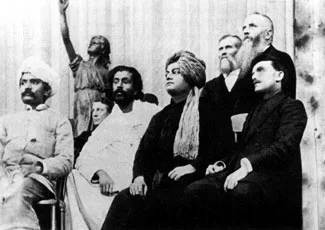
At the World's Parliament of Religions, Chicago 11th September, 1893, Swami Vivekananda said the following few words and achieved an astonishing result: from obscurity to overnight fame came the opportunity to effect change upon the entire world. This may well be, literally, the most famous and hist

Books

Ramakrishna - his life and sayings

By Swami Vivekananda · January 1, 1900

300. The new-born calf looks very lively, blithe, and merry. It jumps and runs all day long, and only stops to suck the sweet milk from its darn. But no sooner is the rope placed round its neck than it begins to pine away gradually, and, far from being merry, wears a dejected and sorry appeara

Ramakrishna - his life and sayings
Books

Ramakrishna - his life and sayings

By Swami Vivekananda · January 1, 1900

100. A man who finds all the hairs of his body standing on end at the bare mention of S rî Hari's name, through sheer ecstasy, and who sheds tears of love on hearing the name of God, he has reached his last birth.

Books

Ramakrishna - his life and sayings

By Swami Vivekananda · January 1, 1900

1. Thou seest many stars at night in the sky, but findest them not when the sun rises. Canst thou say that there are no stars, then, in the heaven of day? So, O man, because thou beholdest not the Almighty in the days of thy ignorance, say not that there is no God.

Books

Ramakrishna - his life and sayings

By Swami Vivekananda · January 1, 1900

Then follows the final conclusion that these two Selfs are one and the same, only reached by different methods. Man is man phenomenally, the world is world phenomenally, the gods of the world are gods phenomenally, but in full reality all are the Godhead, call it Âtman or Brahman, metamorphose

Books

Ramakrishna - his life and sayings

By Swami Vivekananda · January 1, 1900

We may try now another door for an entrance into the Vedânta-philosophy, which may help in bringing the Vedânta nearer to ourselves, or ourselves nearer to the Vedânta, so that it may be looked upon not simply as a strange and curious system, but as a system of thought with which we can sympathi

Books

Ramakrishna - his life and sayings

By Swami Vivekananda · January 1, 1900

If you ask, what then is real in all things and in every individual soul? the answer is, Brahman, the One without a Second, the One besides whom there is nothing; but this answer can be understood by those only who know Avidyâ, and by knowing it have destroyed it. Others believe that the world i

Books

Ramakrishna - his life and sayings

By Swami Vivekananda · January 1, 1900

If now we return to Râmak ri sh n a, I can assure Keshub's zealous advocate that I never looked upon Râmak ri sh n a as the originator of the Vedânta-philosophy. He was not a man possessed of a scholarlike knowledge of the ancient system of the Vedânta-philosophy, nor do I feel certain that even

Books

Ramakrishna - his life and sayings

By Swami Vivekananda · January 1, 1900

A more painful misunderstanding has arisen with regard to the exact relationship between Râmak ri sh n a and Keshub Chunder Sen. A disciple may mean many things, but Keshub Chunder Sen was never chary in giving credit where credit was due, and he was the last man to withhold the name of master an

Books

Ramakrishna - his life and sayings

By Swami Vivekananda · January 1, 1900

Another charge which Mozoomdar seems to consider as proved against Râmak ri sh n a is what he calls his almost barbarous treatment of his wife. What he means is evidently that he forgot or neglected her till she was seventeen years of age. But this can hardly be called barbarous in India, where

Books

Ramakrishna - his life and sayings

By Swami Vivekananda · January 1, 1900

His speech at times was abominably filthy. For all that, he was, as you say, a real Mahâtman, and I would not withdraw a single word I wrote in his praise. Râmak ri sh n a was not in the least a Vedântist, except that every Hindu unconsciously imbibes from the atmosphere around some amount of Ve

Books

Ramakrishna - his life and sayings

By Swami Vivekananda · January 1, 1900

Fortunately in our case we have the testimony not only of Vivekânanda, who, as a devoted disciple of Râmak ri sh n a, might be suspected of partiality, but we have several independent witnesses, some favourable, others unfavourable. Mozoomdar must be counted as a favourable witness. He stands alo

Books

Ramakrishna - his life and sayings

By Swami Vivekananda · January 1, 1900

This is all that Vivekânanda sent me when I had asked him to write down whatever he could gather from his own memory and from communication with Râmak ri sh n a's other disciples. I had warned him repeatedly not to send me

Books

Ramakrishna - his life and sayings

By Swami Vivekananda · January 1, 1900

Râmak ri sh n a, we are told, was born in the village of Kamârpukar, in the Zillah Hugli, situated about four miles to the west of the Jahânâbad subdivision, and thirty-two miles south of Burdwan. His life on earth began on the 20th of February, 1833, and ended the 16th of August, 1886, 1 a.m. 1