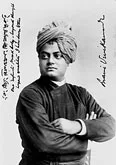
Ramakrishna - his life and sayings
Ramakrishna: His life and sayings
Râmakrishna's Language.
His speech at times was abominably filthy. For all that, he was, as you say, a real Mahâtman, and I would not withdraw a single word I wrote in his praise. Râmakrishna was not in the least a Vedântist, except that every Hindu unconsciously imbibes from the atmosphere around some amount of Vedântism, which is the philosophical backbone of every national cult. He did not know a word of Sanskrit, and it is doubtful whether he knew enough Bengâli. His spiritual wisdom was the result of genius and practical observation.'
There is a ring of truth and impartiality about this, and there is no sign of jealousy, which often breaks out, even in India, among religious reformers and their followers. As to his filthy language, we must be prepared for much plain speaking among Oriental races. In a country where certain classes of men are allowed to walk about in public places stark naked, language too is not likely to veil what with us requires to be veiled. There is, however, a great difference between what is filthy and what is meant to he filthy. I doubt whether the charge of intentional filthiness or obscenity, which has been brought against writers like Zola, could be brought, or has ever been brought, against
[paragraph continues] Râmakrishna. It is quite true that Hindus who belong socially to the higher classes, though not necessarily Brahmans by birth, would be more careful in their expressions. We seldom find any blemishes of that kind in the writings of Rammohun Roy, Keshub Chunder Sen, and their friends. But a certain directness of speech which would be most offensive in England is evidently not regarded in that light in India, and every scholar knows that many of their classical poems, nay, even their Sacred Writings, contain passages which simply do not admit of translation into English. In the three centuries (sataka) of Bhartrihari, treating of worldly wisdom, love, and passionlessness, the second, that of love, has generally been left out in English translations. But the spirit of that Srimgâra-Sataka is by no means the same as that of Zola's novels. On the contrary, the object of the poet is to warn people against voluptuousness, not as something in itself criminal, which has never been an Indian view, but as a hindrance in obtaining that serenity of mind without which the highest objects of life, dispassionateness, serenity, and clear-sightedness can never be obtained. A most useful edition of all the three Satakas has lately been published by Purohit Gopi Nath, M.A., Bombay, 1896.
It should not be forgotten that in Homer, in Shakespeare, nay, even in the Bible, there are passages against which our modern taste revolts, yet we object to Bowdlerised editions, because the indecencies are never of an intentional character, and would seem to have been so, if they were now removed by us.
InstanceEndEditable
InstanceBeginEditable name="Author Credit Bottom"
- www.vivekananda.net edited by Frank Parlato Jr.
InstanceEndEditable