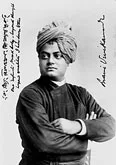
Ramakrishna - his life and sayings
Ramakrishna: His life and sayings
Râmakrishna's wife.
Another charge which Mozoomdar seems to consider as proved against Râmakrishna is what he calls his almost barbarous treatment of his wife. What he means is evidently that he forgot or neglected her till she was seventeen years of age. But this can hardly be called barbarous in India, where it is a recognised custom that a girl of five years of age, as his wife was when he married her, should remain at her parents' house for years before she migrated to the house of her husband and his parents. And that a man in a state such as Râmakrishna is described to have been in should decline to live maritalement, is again by no means unusual in Eastern, nay, in Western countries also.
Vivekânanda told us that when at the age of seventeen his wife went to find him, he received her with real kindness, and that she was quite satisfied to live with him on his own terms, if he would only enlighten her mind and make her to see and to serve God. Such a relationship is by no means without a precedent, and cannot be called barbarous, for volenti non fit injuria. Strange to say, I received not many days ago a letter from an American lady who had gone to visit Râmakrishna's widow, Mrs. S. C. Ole Bull, the widow of the famous violin player, and deeply interested in the religious movements in India. On July 11, 1898, she writes from Srînâgar in Kashmir: 'We were the first foreigners who were allowed to see Sarada-devî, the widow of Râmakrishna. She called us her children, and saying that our visit to her was of the
[paragraph continues] Lord, she felt no strangeness in being with us. When asked to define the obedience to a Guru, who in her case was her husband, she replied to the effect that when one had chosen a Guru or teacher, one should listen to and obey all his directions for spiritual advancement, but in things temporal one could most truly serve a Guru by using one's own best discernment, even if at times it were not in agreement with suggestions given.
'When she gladly gave her husband, to whom she had been united by child-marriage, her assent that he should lead a Samnyâsin's life, she gained his intimate friendship, and became his disciple, receiving daily instruction. During the years of her life with him she was his adviser, praying earnestly for such purity of motive that she might never fail him. She had also taken the vow of poverty and chastity, and in renouncing the natural joys of a mother, she became with him the spiritual parent of many children.'
It is strange that a man of Mozoomdar's knowledge and experience should have considered the resolve of Râmakrishna's wife to live with him as a Samnyâsinî as barbarous treatment. She herself evidently did not think so, nor have I heard of any other cruelties on the part of her husband. If she was satisfied with her life, who has any right to complain; and is love between husband and wife really impossible without the procreation of children? We must learn to believe in Hindu honesty, however incredulous we might justly be on such matters in our own country. Anyhow, I know of no one else who has taken offence at Râmakrishna's spiritual marriage.
InstanceEndEditable
InstanceBeginEditable name="Author Credit Bottom"
- www.vivekananda.net edited by Frank Parlato Jr.
InstanceEndEditable