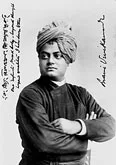
Ramakrishna His life and sayings
Ramakrishna: His life and sayings
Ramakrishna
Such a man was Râmakrishna, who has lately obtained considerable celebrity both in India and America, where his disciples have been actively engaged in preaching his gospel and winning converts to his doctrines, even among Christian audiences. This may seem very strange, nay, almost incredible to us. But we have only to remember what the religion of large numbers of people consists in who call themselves Christians, without even having had an idea of what Christ really taught or what He was meant for in the history of mankind. There are many who know absolutely nothing either of the history or of the doctrines of Christianity, or if they do, they have simply learnt their catechism by heart. They repeat what they have learnt, but without an atom of real faith or love. Yet every human heart has its religious yearnings, it has a hunger for religion which sooner or later wants to be satisfied. Now the religion taught by the disciples of Râmakrishna comes to these hungry souls without any outward authority. So far from being forced on
them, it is to them at first a heathen and despised religion. If they listen to it at all, it is of their own free will; and if they believe in any part of it, it is of their own free choice. A chosen religion is always stronger than an inherited religion, and hence we find that converts from one religion to another are generally so zealous for their new faith, while those who never knew what real religion meant are enthusiastic in proclaiming any truths which they seem to have discovered for themselves and to which their heart has yielded a free assent. Hence, though there may be some exaggeration in the number of those who are stated to have become converted to the religion of Râmakrishna, and though some who now call themselves converts to the Vedânta may in reality have made but the first step towards real Christianity, there can be no doubt that a religion which can achieve such successes in our time, while it calls itself with perfect truth the oldest religion and philosophy of the world, viz. the Vedânta, the end or highest object of the Veda, deserves our careful attention 1.
Râmakrishna himself never claimed to be the founder of a new religion. He simply preached the old religion of India, which was founded on the Veda, more particularly on the Upanishads, and was systematised later on in the Sûtras of Bâdarâyana, and finally developed in the commentaries
of Samkara and others. Even in preaching that religion, and in living the life of a recluse, as he did, Râmakrishna by no means claimed to stand alone. There were several leading Vedânta preachers in India during the last fifty years, sometimes called Paramahamsas. Keshub Chunder Sen, well known in England and America, who was a great reformer with a strong leaning towards Christianity, was not counted as one of them, because he never passed through the proper discipline and did not live the life of a Samnyâsin. But he mentions four among his contemporaries who deserved that title: first, Dayânanda Sarasvatî, for a time unfortunately connected with Madame Blavatsky; secondly, Pawâri Bâba of Ghazipur; thirdly, the Sikh Nagaji of Doomraon; and lastly, our Râmakrishna, commonly called the Paramahamsa of Dakshinesvar. 'These,' he adds, 'are the four ascetic saints whom our friends have from time to time duly honoured, and in whose company they have sought the sanctifying influences of character and example. May we respect,' he continues, 'and serve with profound respect and humility, every ascetic saint whom Providence may bring to us. The impure become pure in the company of Sâdhus.'
Footnotes
11:1 This is the explanation given of the name of Vedânta. But it is probably an after-thought. Like other compounds in anta, such as Siddhânta, Sûtrânta, &c., it was probably meant at first for no more than the subject-matter of the Veda; then, as it stands at the end of Brâhmanas and Âranyakas, it was explained as end of the Veda, and lastly as the end, i.e. the goal, the highest object of the Veda.
- www.vivekananda.net edited by Frank Parlato Jr.