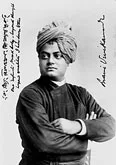
Ramakrishna - his life and sayings
Ramakrishna: His life and sayings
Remarks on
Râmakrishna's Life.
This is all that Vivekânanda sent me when I had asked him to write down whatever he could gather from his own memory and from communication with Râmakrishna's other disciples. I had warned him repeatedly not to send me
mere fables, such as I had read about his Guru in several Indian periodicals, and I believe he fully understood what I meant. Yet we can hardly fail to see the first beginnings of the ravages which the Dialogic Process works even in the first generation. Given his own veneration for his departed master, there is a natural unwillingness, nay, an incapability, to believe or to repeat anything that might place his master in an unfavourable light. Besides, his master was dead when these records were written, and the de mortuis nihil nisi bonum is deeply engraved in every human heart. What is believed and told by everybody in a small village, chiefly by his friends and admirers, is not likely to be contradicted; and if once a man is looked upon as different from others, as possessed of superhuman and miraculous powers, everybody has something new to add in confirmation of what everybody is ready to believe, while a doubt or a denial is treated as a sign of unkindness, possibly of envy or malice. The story, for instance, of the Brahman lady who was sent as a messenger and teacher to Râmakrishna, will sound to us far from probable. But when I first heard of it, this lady was represented as a kind of goddess who met her pupil in a forest and instructed him, like another Sarasvatî, in all the Vedas, Purânas, and philosophies. The difficulty that had to be solved by this heavenly apparition was, no doubt, the fact that Râmakrishna had never received a proper classical education, and yet spoke with authority about the ancient literature and religion of his countrymen. The fact that he was ignorant of Sanskrit, nay, that he did not know a single word of the sacred language of India, is
denied by nobody, and has been distinctly asserted by one of his great admirers, the Rev. P. C. Mozoomdar. Of course he knew Bengâli, and a man who speaks Bengâli can guess the meaning of Sanskrit as an Italian may guess the meaning of Latin. Some of the classical Sanskrit texts exist in Bengâli translations, and may have given him all the information which he wanted for his own purposes, to say nothing of his constant intercourse with learned men who would have warned him against mistakes and answered any question he chose to ask. Thus the Dea ex machina was really not wanted. If this Brahman lady was called a goddess, we must remember that Devî is not much more than a title of honour given to high-born and illustrious ladies, nay, that an exceptionally well-informed and en-lightened lady might well have been spoken of as an incarnation of the goddess Sarasvatî. In India the distance between deity and humanity is very small; gods are believed to become men, and men gods, without much ado about it.
InstanceEndEditable
InstanceBeginEditable name="Author Credit Bottom"
- www.vivekananda.net edited by Frank Parlato Jr.
InstanceEndEditable