
Poetry & Prose
Teachings of Swami Vivekananda by Topic
By Swami Vivekananda · January 1, 1900
(Fragmentary notes of a lecture recorded by Ida Ansell and reprinted from Vedanta and the West , July-August 1957.)
(Fragmentary notes of a lecture recorded by Ida Ansell and reprinted from Vedanta and the West , July-August 1957.)
( Delivered in Detroit on March 19, 1894: Reported in Detroit Tribune )
( Delivered in Memphis on January 21, 1894: Reported in Appeal-Avalanche )
( Delivered in Memphis on January 19, 1894: Reported in Appeal-Avalanche )
( Delivered in Memphis on January 17, 1894: Reported in Appeal-Avalanche )
( Delivered in Minneapolis on November 26, 1893: Reported in the Minneapolis Journal )
In order that a nation may rise, it must have a high ideal. Now, that ideal is, of course, the abstract Brahman. But as you all cannot be inspired by an abstract ideal, you must have a personal ideal. You have got that, in the person of Shri Ramakrishna. The reason why other personages cannot be
By force, think of one thing at least as Brahman. Of course it is easier to think of Ramakrishna as God, but the danger is that we cannot form Ishvara-buddhi (vision of Divinity) in others. God is eternal, without any form, omnipresent. To think of Him as possessing any form is blasphemy. But the
In a narrow society there is depth and intensity of spirituality. The narrow stream is very rapid. In a catholic society, along with the breadth of vision we find a proportionate loss in depth and intensity. But the life of Sri Ramakrishna upsets all records of history. It is a remarkable phenome
In the course of a conversation Swamiji spiritedly remarked, "Leave off your commercial calculating ideas. If you can get rid of your attachment to a single thing, you are on the way to liberation. Do not see a public woman, or sinner, or Sâdhu. That vile woman also is the Divine Mother. A Sanny

Talking of the respective duties of a monk and a householder, Swamiji said: A Sannyasin should avoid the food, bedding, etc., which have been touched or used by householders, in order to save himself — not from hatred towards them — so long as he has not risen to the highest grade, that is, become
You preach to others to be men but cannot give them good food. I have been thinking over this problem for the last four years. I wish to make an experiment whether something of the nature of flattened rice can be made out of wheat. Then we can get a different food every day. About drinking water
Man's inner hankering is to find some one who is free, that is, beyond the laws of nature. The Vedantins believe in such an Eternal Ishvara, while the Buddhists and the Sânkhyas believe only a Janyeshvara (created God), that is, a God who was a man before, but has become God through spiritual pr
The Mantra-Shâstris (upholders of the Mantra theory) believe that some words have been handed down through a succession of teachers and disciples, and the mere utterance of them will lead to some form of realisation. There are two different meanings of the word Mantra-chaitanya. According to some
In art, interest must be centred on the principal theme. Drama is the most difficult of all arts. In it two things are to be satisfied — first, the ears, and second, the eyes. To paint a scene, if one thing be painted, it is easy enough; but to paint different things and yet to keep up the centra
The cause becomes the effect. The cause is not one thing and the effect something else that exists as a result. The effect is always the cause worked out. Always, the cause becomes the effect. The popular idea is that the effect is the result of the operation of a cause which is something indepe
Religion is the realisation of Spirit as Spirit; not Spirit as matter. Religion is a growth. Each one must experience it himself. The Christians believe that Jesus Christ died to save man. With you it is belief in a doctrine, and this belief constitutes your salvation. With us doctrine has nothi
Dualism recognises God and nature to be eternally separate: the universe and nature eternally dependent upon God. The extreme monists make no such distinction. In the last analysis, they claim, all is God: the universe becomes lost in God; God is the eternal life of the universe. With them infini
Anything that is in space has form. Space itself has form. Either you are in space, or space is in you. The soul is beyond all space. Space is in the soul, not the soul in space. Form is confined to time and space and is bound by the law of causation. All time is in us, we are not in time. As the
The Vedic sacrificial altar was the origin of Geometry. The invocation of the Devas, or bright ones, was the basis of worship. The idea is that one invoked is helped and helps. Hymns are not only words of praise but words of power, being pronounced with the right attitude of mind. Heavens are only
This world is not for cowards. Do not try to fly. Look not for success or failure. Join yourself to the perfectly unselfish will and work on. Know that the mind which is born to succeed joins itself to a determined will and perseveres. You have the right to work, but do not become so degenerate
Bhakti-Yoga is the path of systematised devotion for the attainment of union with the Absolute. It is the easiest and surest path to religion or realisation. Love to God is the one essential to be perfect in this path. There are five stages of love. First, man wants help and has a little fear. Sec
The dualist thinks you cannot be moral unless you have a God with a rod in His hand, ready to punish you. How is that? Suppose a horse had to give us a lecture on morality, one of those very wretched cab-horses who move only with the whip, to which he has become accustomed. He begins to speak ab
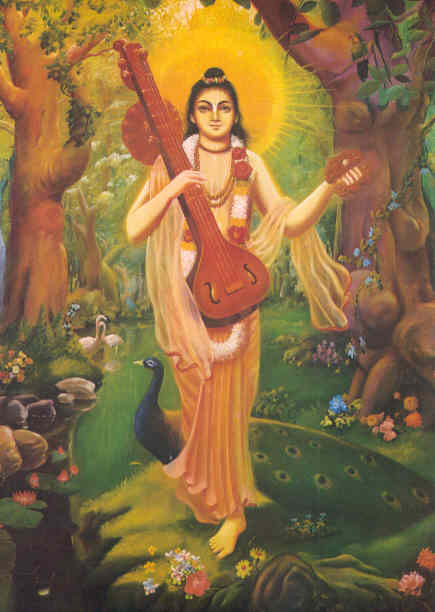
The Bhakti Sutras is a classic work of Hinduism, and consists of connected aphorisms (or sutras) on Bhakti - and purportedly composed in Sanskrit by Narada Muni, an ancient, and, perhaps, mythological sage.
(These lessons are from class notes preserved in England.)
The theory of Ishta, which I briefly referred to before, is a subject requiring careful attention because with a proper understanding of this, all the various religions of the world can be understood. The word Ishta is derived from the root Ish, to desire, choose. The ideal of all religions, all
There are two Sanskrit words, Pratika and Pratimâ. Pratika means coming towards, nearing. In all countries you find various grades of worship. In this country, for instance, there are people who worship images of saints, there are people who worship certain forms and symbols. Then there are peop
Bhakti is divided into two portions. One is called Vaidhi, formal or ceremonial; the other portion is called Mukhyâ, supreme. The word Bhakti covers all the ground between the lowest form of worship and the highest form of life. All the worship that you have seen in any country in the world, or
Every soul is destined to be perfect, and every being, in the end, will attain to that state. Whatever we are now is the result of whatever we have been or thought in the past; and whatever we shall be in the future will be the result of what we do or think now. But this does not preclude our re
The philosophers who wrote on Bhakti defined it as extreme love for God. Why a man should love God is the question to be solved; and until we understand that, we shall not be able to grasp the subject at all. There are two entirely different ideals of life. A man of any country who has any relig