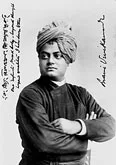
The Power of the Mind - Teachings of Swami Vivekananda by Topic
The Power of the Mind
The cause becomes the effect. The cause is not one thing and the effect something else that exists as a result. The effect is always the cause worked out. Always, the cause becomes the effect. The popular idea is that the effect is the result of the operation of a cause which is something independent and aloof from the effect. This is not so. The effect is always the cause worked out into another condition.
The universe is really homogeneous. Heterogeneity is only in appearance. There seem to be different substances, different powers, etc. throughout nature. But take two different substances, say a piece of glass and a piece of wood, grind them up together fine enough, reduce them till there is nothing more to reduce, and the substance remaining appears homogeneous. All substances in the last analysis are one. Homogeneity is the substance, the reality; heterogeneity is the appearance of many things as though they were mans' substances. The One is homogeneity; the appearance of the One as many is heterogeneity.
Hearing, seeing, or tasting, etc. is the mind in different states of action.
The atmosphere of a room may be hypnotised so that everybody who enters it will see all sorts of things — men and objects flying through the air.
Everybody is hypnotised already. The work of attaining freedom, of realising one's real nature, consists in de-hypnotisation.
One thing to be remembered is that we are not gaining powers at all. We have them already. The whole process of growth is de-hypnotisation.
The purer the mind, the easier it is to control. Purity of the mind must be insisted upon if you would control it. Do not think covetously about mere mental powers. Let them go. One who seeks the powers of the mind succumbs to them. Almost all who desire powers become ensnared by them.
Perfect morality is the all in all of complete control over mind. The man who is perfectly moral has nothing more to do; he is free. The man who is perfectly moral cannot possibly hurt anything or anybody. Non-injuring has to be attained by him who would be free. No one is more powerful than he who has attained perfect non-injuring. No one could fight, no one could quarrel, in his presence. Yes, his very presence, and nothing else, means peace, means love wherever he may be. Nobody could be angry or fight in his presence. Even the animals, ferocious animals, would be peaceful before him.
I once knew a Yogi, a very old man, who lived in a hole in the ground all by himself. (Pavhâri Bâbâ of Ghazipur. ) All he had was a pan or two to cook his meals in. He ate very little, and wore scarcely anything, and spent most of his time meditating.
With him all people were alike. He had attained to non-injuring. What he saw in everything, in every person, in every animal, was the Soul, the Lord of the Universe. With him, every person and every animal was "my Lord". He never addressed any person or animal in any other way. Well, one day a thief came his way and stole one of his pans. He saw him and ran after him. The chase was a long one. At last the thief from exhaustion had to stop, and the Yogi, running up to him, fell on his knees before him and said, "My Lord, you do me a great honour to come my way. Do me the honour to accept the other pan. It is also yours." This old man is dead now. He was full of love for everything in the world. He would have died for an ant. Wild animals instinctively knew this old man to be their friend. Snakes and ferocious animals would go into his hole and sleep with him. They all loved him and never fought in his presence.
Never talk about the faults of others, no matter how bad they may be. Nothing is ever gained by that. You never help one by talking about his fault; you do him an injury, and injure yourself as well.
All regulations in eating, practicing, etc., are all right so long as they are complementary to a spiritual aspiration but they are not ends in themselves; they are only helps.
Never quarrel about religion. All quarrels and disputations concerning religion simply show that spirituality is not present. Religious quarrels are always over the husks. When purity, when spirituality goes, leaving the soul dry, quarrels begin, and not before.
InstanceEndEditable
InstanceBeginEditable name="Author Credit Bottom"
- www.vivekananda.net edited by Frank Parlato Jr.
InstanceEndEditable