
Biographical
T
By Swami Vivekananda · January 1, 1900
HINK OF D EATH A LWAYS AND N EW L IFE W ILL C OME W ITHIN — W ORK FOR O THERS — G OD THE L AST R EFUGE
HINK OF D EATH A LWAYS AND N EW L IFE W ILL C OME W ITHIN — W ORK FOR O THERS — G OD THE L AST R EFUGE

INDIA WANTS NOT LECTURING BUT WORK — THE CRYING PROBLEM IN INDIA IS POVERTY — YOUNG SANNYASINS TO BE TRAINED BOTH AS SECULAR AND SPIRITUAL TEACHERS AND WORKERS FOR THE MASSES — EXHORTATIONS TO YOUNG MEN TO WORK FOR OTHERS
REMINISCENCES — THE PROBLEM OF FAMINES IN INDIA AND SELF-SACRIFICING WORKERS — EAST AND WEST — IS IT SATTVA OR TAMAS — A NATION OF MENDICANTS — THE "GIVE AND TAKE" POLICY — TELL A MAN HIS DEFECTS DIRECTLY BUT PRAISE HIS VIRTUES BEFORE OTHERS — VIVEKANANDA EVERYONE MAY BECOME — UNBR
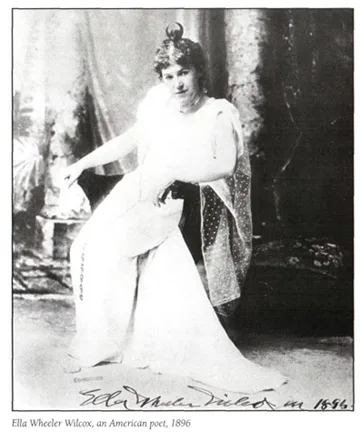
Ella Wheeler Wilcox met Swami Vivekananda in NY 1895. The following is from her book 'The World and I'. (George H. Doran Co., NY. 1918) The year following the Chicago Exposition and Congress of Religions, the East Indian Monk, Swami Vivekananda, came to New York and gave a course
of the Swami's early classes in NY: Those first classes!. How intensely interesting they were! Who that was privileged to attend them can ever forget them! The Swami dignified, yet simple, so gravely earnest, so eloquent, and the close ranks of students, forgetting all inconveniences, hanging
1. Calcutta, February 15, 1899 : My lecture on Kali came off on Monday. The Albert Hall was crammed. The Chairman spoke against Kali and me, and was very touching, when unfortunately a devotee got up and amidst tremendous excitement called him all sorts of names. I am sorry to tell you that I
One day, as I was walking up Madison Avenue, I saw in the window of the Hall of the Universal Brotherhood a modest sign saying: "Next Sunday at 3 p.m. Swami Vivekananda will speak here on `What is Vedanta?' and the following Sunday on `What a Yoga?' " I
Recalling the Swami’s lecture on the Bhagavadgita sometime in 1895, she was quoted as saying, later: "I saw with these very eyes (she pointed to her own eyes) Krishna himself standing there and preaching the Gita. That was my first wonderful vision. I stared and stared. . . .I saw only the f
"In the beginning crowds of people flocked to his lectures. But they were not of the kind that a teacher of religion would be pleased to have for his auditors. They consisted partly of curiosity-seekers who were more interested in the personality of the preacher than in what he had to prea

February l4th, 1894, stands out in my memory as a day apart, a sacred, holy day; for it was then that I first saw the form and listened to the voice of that great soul, that spiritual giant, the Swami Vivekananda, who, two years later, to my great joy and never-ceasing wonder, accepted me as
Cornelia Conger, was the granddaughter of Mr. and Mrs. John Lyons, the Swami’s first hosts in Chicago in September 1893. She was six years old when she met the Swami and wrote of him in part:
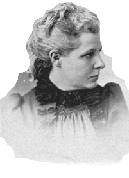
A striking figure, clad in yellow and orange, shining like the sun of India in the midst of the heavy atmosphere of Chicago, a lion head, piercing eyes, mobile lips, movements swift and abrupt –– such was my first impression of Swami Vivekananda, as I met him in one of the rooms set apart fo
[At the end of August 1893, Swami Vivekananda stayed at Annisquam at the house of Prof. J. H. Wright. So astonishing a sight did Swamiji present in this quiet little New England village that speculations set in at once as to who this majestic and colourful figure might be. From where had he come
Vaikunthanath Sanyal, one of the householder disciples of Ramakrishna, visited the Master at Dakshineswar. He recalled: "The Master was that day full of praise for Narendranath. Talking about him made him so desirous of seeing him that he was completely overwhelmed, and could no longer control h
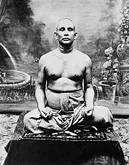
Sri Ramakrishna did not allow everybody to practice the nondual aspect of meditation. What good is it to proclaim that you are one with the Absolute unless the universe has vanished from your consciousness? Sri Ramakrishna used to say: ‘You may say that there is no thorn, but put your hand out—t
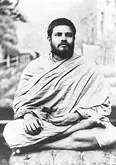
Swami Saradananda wrote of Bhubaneswari and the period of time following her husband’s death in February 1884: Fallen on bad days after her husband's death, she was put on her mettle and showed wonderful patience, calmness, frugality and adaptability to sudden change of circumstances. She who was
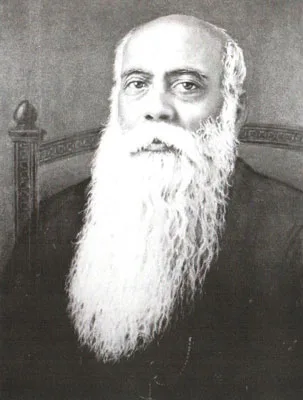
Swami Vivekananda’s classmate, Dr. Brajendranath Seal, wrote in an article published in the Prabuddha Bharata (April 1907; reprinted Brahmavadin, May, 1907):
India is a rotten corpse inside and outside. We shall revive it by the blessings of Shri Maharaj. (Letter to Ramakrishnananda 25th February, 1898 .)
When I first came to America , they ill-treated me if I had not trousers on. Next I was forced to wear cuffs and collars, else they would not touch me etc., etc. They thought me awfully funny if I did not eat what they offered etc., etc. . .
I once had a book sent me, which said I must believe everything told in it. It said there was no soul, but that there were gods and goddesses in heaven, and a thread of light going from each of our heads to heaven! How did the writer know all these things? She had been inspired, and wanted me to
I remember a woman whose husband was a great drunkard, and she complained to me of his becoming so. I replied, "Madam, if there were twenty millions of wives like yourself, all husbands would become drunkards." I am convinced that a large number of drunkards are manufactured by their wives. My b
There are fanatics of various kinds. Some people are wine fanatics and cigar fanatics. Some think that if men gave up smoking cigars, the world would arrive at the millennium. Women are generally amongst these fanatics. There was a young lady here one day, in this class. She was one of a number
In America there was a great agnostic, a very noble man, a very good man, and a very fine speaker. He lectured on religion, which he said was of no use; why bother our heads about other worlds? He employed this simile; we have an orange here, and we want to squeeze all the juice out of it. I met him
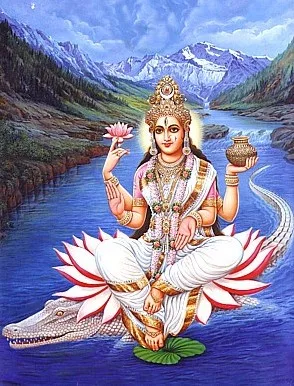
The Gita and the sacred waters of the Ganga constitute the Hinduism of the Hindus. Last time I went to the West, I also took a little of it with me, fearing it might be needed, and whenever opportunities occurred I used to drink a few drops of it. And every time I drank, in the midst of the stre
In Chicago, the other day, a funny thing happened. The Raja of Kapurthala was here, and he was being lionised by some portion of Chicago society. I once met the Raja in the Fair grounds, but he was too big to speak with a poor Fakir. There was an eccentric Mahratta Brahmin selling nail-made pic

"I saw many great men in Hrishikesh. One case that I remember was that of a man who seemed to be mad. He was coming nude down the street, with boys pursuing and throwing stones at him. The whole man was bubbling over with laughter while blood was streaming down his face and neck. I took him
Mr.Ramnath was the headmaster of the Jeypore noble’s school. He and the Swmi had a debate about vegetarianism when the swami first left Khetri after his first visit there.
In the said village lives a man of the Chetty caste, generally passing for an astrologer. I, with two other young men, went to see him. He was said to tell about anything a man thinks of. So, I wanted to put him to the test. Two months ago, I dreamt that my mother was dead and I was very anx
One day Ramakrishna tried to instruct Naren on the identity of the individual soul with Brahman. Narendra left the room, and going to Hazra said, "How can this be? This jug is God, this cup is God and we too are God: nothing can be more preposterous!" On hearing Naren's laughter, Ramakrishna, who
(As quoted by the 'Life of Swami Vivekananda by his Eastern and Western Disciples')