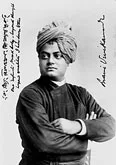
Advaita Vedanta
(Probably 1883)
One day Ramakrishna tried to instruct Naren on the identity of the individual soul with Brahman.
Narendra left the room, and going to Hazra said, "How can this be? This jug is God, this cup is God and we too are God: nothing can be more preposterous!"
On hearing Naren's laughter, Ramakrishna, who was in his room in a state of semi-consciousness, came out nude, with his cloth under his arm. He said, smiling, "Hello there what are you talking about?" Then touched Narendra and went into Samadhi.
Naren recalled what happened afterward:
The magic touch of the Master that day immediately brought a wonderful change over my mind. I was astounded to find that really there was nothing in the universe but God! I saw it quite clearly, but kept silent to see whether the impression would last; but it did not abate in the course of the day. I returned home, but there too, everything I saw appeared to be Brahman. I sat down to take my meal, but found that everything -- the food, the plate, the person who served, and even myself was nothing but That. I ate a-morsel or two and sat still. I was startled by my mother's words, "Why do you sit still? Finish your meal", and then began to eat again. But all the while, whether eating or lying down, or going to College, I had the same experience and felt myself always in a sort of trance. While walking in the streets, I noticed cabs plying, but I did not feel inclined to move out of the way. I felt that the cabs and myself were one. There was no sensation in my limbs, which seemed were going to become paralysed.
I did not relish eating, and felt as if somebody else were eating. Sometimes I lay down during a meal; after a few minutes I got up and again began to eat. The result would be that on some days I would take too much, but it did no harm. My mother became alarmed and said that there must be something wrong with me. She was afraid that I might not live long. When there was a slight change in this state, the world began to appear dream-like. While walking in Cornwallis Square, I would strike my head against the iron railings to see if they were real or only a dream. This state of things continued for some days. When I became normal again, I realized that I must have had a glimpse of the Advaita state. Then it struck me that the words of the scriptures were not false. Thenceforth I could not deny the conclusions of the Advaita philosophy.
InstanceEndEditable
InstanceBeginEditable name="Author Credit Bottom"
- www.vivekananda.net edited by Frank Parlato Jr.
InstanceEndEditable