The Greatest Sacrifice
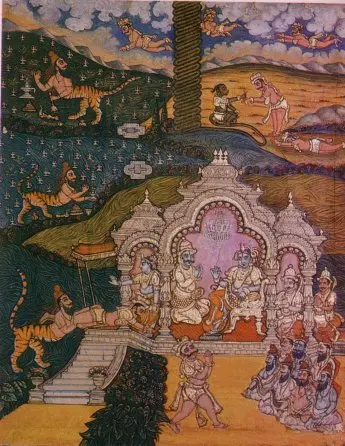
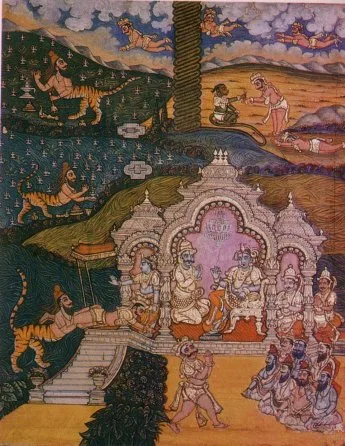 This idea of complete self-sacrifice is illustrated in the following story: After the battle of Kurukshetra the five Pandava brothers performed a great sacrifice and made very large gifts to the poor. All people expressed amazement at the greatness and richness of the sacrifice, and said that such a sacrifice the world had never seen before. But, after the ceremony, there came a little mongoose, half of whose body was golden, and the other half brown; and he began to roll on the floor of the sacrificial hall.
He said to those around, "You are all liars; this is no sacrifice."
"What!" they exclaimed, "you say this is no sacrifice; do you not know how money and jewels were poured out to the poor and every one became rich and happy? This was the most wonderful sacrifice any man every performed."
But the mongoose said, "There was once a little village, and in it there dwelt a poor Brahmin with his wife, his son, and his son's wife. They were very poor and lived on small gifts made to them for preaching and teaching. There came in that land a three years' famine, and the poor Brahmin suffered more than ever. At last when the family had starved for days, the father brought home one morning a little barley flour, which he had been fortunate enough to obtain, and he divided it into four parts, one for each member of the family. They prepared it for their meal, and just as they were about to eat, there was a knock at the door.
"The father opened it, and there stood a guest. Now in India a guest is a sacred person; he is as a god for the time being, and must be treated as such. So the poor Brahmin said, "Come in, sir; you are welcome." He set before the guest his own portion of the food, which the guest quickly ate and said, "Oh, sir, you have killed me; I have been starving for ten days, and this little bit has but increased my hunger." Then the wife said to her husband, "Give him my share," but the husband said, "Not so." The wife however insisted, saying, "Here is a poor man, and it is our duty as householders to see that he is fed, and it is my duty as a wife to give him my portion, seeing that you have no more to offer him." Then she gave her share to the guest, which he ate, and said he was still burning with hunger. So the son said, "Take my portion also; it is the duty of a son to help his father to fulfil his obligation." The guest ate that, but remained still unsatisfied; so the son's wife gave him her portion also. That was sufficient, and the guest departed, blessing them.
"That night those four people died of starvation. A few granules of that flour had fallen on the floor; and when I rolled my body on them, half of it became golden, as you see. Since then I have been travelling all over the world, hoping to find another sacrifice like that, but nowhere have I found one; nowhere else has the other half of my body been turned into gold. That is why I say this is no sacrifice."
InstanceEndEditable
InstanceBeginEditable name="Author Credit Bottom"
- www.vivekananda.net edited by Frank Parlato Jr.
InstanceEndEditable