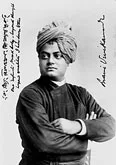
School and College Days
At one time my ideal was to drive a strong pair of horses; at another time I thought, if I could make a certain kind of sweetmeat, I should be perfectly happy; later I imagined that I should be entirely satisfied if I had a wife and children and plenty of money. Today I laugh at all these ideals as mere childish nonsense.
Naren used to go to his maternal grandmother’s house where he had his own room. Referring to this room, his college days, and his cramming for examinations, he said: "I sat in the room, book in hand, with a pot of strong tea or coffee by my side to keep the brain from getting overtired. When I felt inclined to sleep at night, I would tie a rope to my foot. Then, if I fell asleep and moved to make myself more comfortable, the rope would jerk me, and I would awake with a start."
Vivekananda (as quoted by Swami Saradananda) described a “vision” he had after meditation in his home during his college days:
When I kept my mind still and devoid of all objects, there flowed in it a current of serene bliss. Under its influence, I felt a sort of intoxication for a long time even after the end of the meditation; so I did not feel inclined to leave my seat and get up immediately. One day when I was sitting in that condition at the end of the meditation, I saw the wonderful figure of a monk appear suddenly-from where I did not know-and stand before me at a little distance, filling the room with a divine effulgence. He was in ochre robes with a Kamandalu (water-pot) in his hand. His face bore such a calm and serene expression of inwardness born of indifference to all things, that I was amazed and felt much drawn to him. He walked towards me with a slow step, his eyes steadfastly fixed on me, as if he wanted to say something. But I was seized with fear and could not keep still. I got up from my seat, opened the door, and quickly left the room. The next moment I thought, "Why this foolish fear?" I became bold and went back into the room to listen to the monk, who, alas, was no longer there. I waited long in vain, feeling dejected and repenting that I had been so stupid as to flee without listening to him. I have seen many monks, but never have I seen such an extraordinary expression on any other face. That face has been indelibly printed on my heart. It may have been a hallucination; but very often I think that I had the good Fortune of seeing Lord Buddha that day.
InstanceEndEditable
InstanceBeginEditable name="Author Credit Bottom"
- www.vivekananda.net edited by Frank Parlato Jr.
InstanceEndEditable