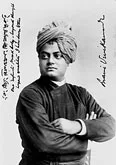
Reminiscences of Swami Vivekananda
ALTHOUGH I am not to be present at your gathering in remembrance of your great predecessor, Swami Vivekananda, I think those present may like to have a pen-picture of him from one who was very closely associated with him.
It is now some forty years since Vivekananda left this country, but the impression that he left with me is as vivid now as on the day that I said farewell to him.
I think this is largely accounted for — for I am not strong in reminiscence — by a quality in him which is described by a Sanskrit word ojas: it signifies bodily strength, virility and also vitality and splendour.
In fact he had a magnetic personality, associated with great tranquillity. Whether he was walking in the street or standing in a room, there was always the same dignity.
He had a great sense of humour and as a natural correlative, much pathos and pity for affliction. He was a charming companion and entered with ease into any environment he found. And I found that all classes of educated persons that he was brought in contact with looked up to and admired the innate nobility that was in the man. One felt at all limes that he was, to use a modern expression, "conscious of the presence of God". In walking, travelling, and leisure times, there constantly came from him some hardly formulated invocation or expression of devotion.
As a teacher he had a great capacity for perceiving the difficulty of an inquirer, and would elucidate it with great simplicity and point to its solution. At the same time he could enter into great intricacies of thought.
I remember well his discussion with Dr. Paul Deussen, the then head of Kiel University. He pointed out where Schopenhauer and Von Hartmann were wrong in founding their philosophy upon the blind will, the Unconscious, as contrasted with Universal Thought, which must precede all desiring or willing. Unfortunately that error continues today and vitiates a great deal of Western psychology by its using a wrong terminology.
I will close this by remarking that, although if we were enlightened we should see Deity in every manifestation, nevertheless it is a great boon when we can perceive it as patent in noble and holy men. One of such was the Swami Vivekananda.
(Vedanta Kesari, February 1937)
InstanceEndEditable
InstanceBeginEditable name="Author Credit Bottom"
- www.vivekananda.net edited by Frank Parlato Jr.
InstanceEndEditable