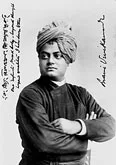
John Lincoln Blauss
The writer disturbed by the influence Vivekananda had on the Ethical Society of Brooklyn wrote a letter to the editor of the New York Times. He is probably referring to lectures Vivekananda made to this group in late 1894 and early 1895. Dr. Charles Higgins wrote a letter of response to Blauss’s letter.
JOHN LlNCOLN BLAUSS
New York Times May 24, 1897
Letter to the editor.
DROPPING INTO BUDDHISM.
The Brooklyn Ethical Society is an attempt on the part of women and men of respectable mental endowments to substitute for supernatural authority a purely scientific basis for the sanctions of moral conduct. Orthodox teaching, they felt, was no longer credible, and should be superseded by something which would satisfy the untrammeled intellect. As a result they accepted tentatively as final the philosophical scheme of Mr. Spencer and proceeded diligently to retail to the community in biweekly dilutions the outgivings of their celebrated master, applying the doctrine of evolutionary science to all current religious, economic, social, and political problems with that self-complacency and cocksureness which are attributes of infallibility. This, it should be noticed, was the first slip in that remarkable descent into the slouch of fatuous credulity which a number of these astonishing being's have now achieved. | The plunge was facilitated after the advent on our shores of that learned philosophical quack Swami Virikauanda, who
represented Buddhism at the Congress of Religions at Chicago. This remarkable genius was induced to expound the dogmas of his religion to the members of the Ethical Society.
The writer was present at several of these meetings, and had occasion to note how receptive the field of credulity had already become and with what solemn emotion these superior persons listened to the meaningless circumlocutions of the fat and invariably smiling priest of Buddha. The situation demanded a strong blast of withering common-sense such as that which I have heard delivered from the pulpit of the Second Unitarian Church! But everybody appeared to have been hypnotized into that primitive state of mind which regards with awe what it does not understand. Had the place of this exotic priest been occupied by some earnest and faithful teacher of Christian ethics, I venture to say that his auditors would have had upon their faces, instead of the afflatus of stirred sensibility a look of bored and patronizing contempt. To them the teaching of Christ and the fruits of that teaching had become commonplace and vapid.
InstanceEndEditable
InstanceBeginEditable name="Author Credit Bottom"
- www.vivekananda.net edited by Frank Parlato Jr.
InstanceEndEditable