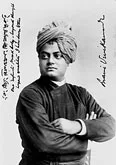
Sri Ramakrishna

Teachings of Sri Ramakrishna
 (1884) Sri Ramakrishna was in his room at Dakshineswar surrounded by disciples, including Naren.
The Vaishnava religion.
This religion enjoins upon its followers the practice of three things: relish for the name of God, compassion for all living creatures, and the service of the Vaishnavas, the devotees of the Lord. The real meaning of these precepts is this: God is not different from His name; therefore one should always repeat His name. God and his devotee, Krishna and the Vaishnava, are not separate from one another; therefore one should show respect to all saints and devotees. Realizing that this world belongs to Shri Krishna, one should show compassion to all creatures."
Hardly had he uttered the words "compassion to all creatures", when he went into Samadhi. After a while he came back to a semiconscious state of mind and said to himself: "Compassion for creatures! Compassion for creatures! You fool! An insignificant worm crawling on earth, you to show compassion to others! Who are you to show compassion? No, it cannot be. Not compassion for others, but rather the service of man, recognizing him to he a veritable manifestation of God."
When the disciples left the room, Naren said to them:
What wonderful light I have seen in these words of the Master! How beautifully he has reconciled the ideal of Bhakti with the knowledge of Vedanta, generally interpreted as dry, austere, and incompatible with human sentiments! What a grand, natural and sweet synthesis! The usual idea is the practice of the knowledge of Vedanta demands complete withdrawal from society and rooting out all sentiments such as love, devotion and compassion. Cherishing hatred of the world and of fellow creatures, thinking them impediments to spiritual attainment, the aspirant goes astray. But from these words of the Master uttered in his ecstasy, I now understand the ideal of Vedanta, lived by the recluse, outside the pale of society, can be practiced even at home and applied to every aspect of daily life. Whatever a man's vocation, let him understand and realize that it is God alone who has manifested Himself as the world and all its creatures. He is both immanent and transcendent. It is He who has become all the diverse beings, objects of our love, respect or compassion, and yet He is beyond all these. Such a realization of Divinity in all humanity leaves no room for arrogance. By realizing it, a man can never be jealous, or have pity for another. Serving man, knowing him to be the manifestation of God serves to purify the heart; and, in a short time, the aspirant realizes that he is a part of God-Existence-Knowledge-Bliss Absolute.
These words of the Master also throw new light on the path of devotion. Real devotion is far away until the aspirant realizes the immanence of God. By realizing Him in and through all beings and by serving Him in them, the devotee acquires true devotion. Those following the paths of work and Yoga are similarly benefited by these words of the Master. The embodied being cannot remain even for a minute without activity. All his activities should be directed to the service of man, the manifestation of God upon earth, and this will accelerate his progress towards the goal.
If it be the will of God, the day will soon come when I shall proclaim this grand truth to the world at large. I shall make it the common property of all, the wise and the fool, the rich and the poor, the Brahmin and the Pariah.
Bhakti
In this Kali-Yuga the only way to cultivate spirituality is by chanting the name of the Lord and following the path of devotion as marked out by the sage Narada.
InstanceEndEditable
InstanceBeginEditable name="Author Credit Bottom"
- www.vivekananda.net edited by Frank Parlato Jr.
InstanceEndEditable