Prose: Reason, Faith and Love
Reason, Faith and Love
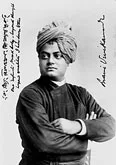
[Swamiji had made the home of the Hale family his headquarters during almost all of 1894 before the pivot of his activities moved eastward to the Atlantic Coast. It was on George W. Hale's letter paper and thus, presumably, during one of his stays in the latter's home, that Swamiji jotted down in pencil a series of notes on the subjects of reason, faith, and love, which have recently come to light. Unfortunately the date of the manuscript cannot be accurately determined.]
Reason — has its limits — its base — its degeneration. The walls round it — Agnosticism. Atheism. But must not stop The beyond is acting upon influencing us every moment — the sky the stars acting upon us — even those not seen. Therefore must go beyond — reason alone can't go — finite cannot get at the infinite
Faith its degeneration when alone — bigotry fanaticism — sectarianism. Narrowing finite therefore cannot get to the infinite Sometimes gain in intensity but loses in extensity — and in bigots & fanatics become worship of his own pride & vanity
Is there no other way — there is Love it never degenerates — peaceful softening ever widening — the universe is too small for its expansiveness.
We cannot define it we can only trace it through its development and describe its surroundings
It is at first — what the gravitation is to the external world — a tendency to unification forms and conventionalities are its death. Worship through forms — methods — services forms — up to then no love.
When love comes method dies. Human language and human forms God as father, God as mother, God as the lover — Surata-vardhanam etc. Solomon's Song of Songs — Dependence and independence Love Love —
Love the chaste wife — Anasuya Sita — not as hard dry duty but as ever pleasing love — Sita worship —
The madness of Love — God intoxicated man The allegory of Radha — misunderstood The restriction more increase — Lust is the death of love Self is the death of love individual to general Concrete to abstract — to absolute The praying Mohammedan and the girl The Sympathy — Kabir — The Christian nun from whose hands blood came The Mohammedan Saint Every particle seeking its own complement When it finds that it is at rest Every man seeking — happiness — & stability The search is real but the objects are themselves but happiness is coming to them momentary at least through the search of these objects.
The only object unchangeable and the only complement of character and aspirations of the human Soul is God.
Love is struggle of a human Soul to find its complement its stable equilibrium its infinite rest.
InstanceEndEditable
InstanceBeginEditable name="Author Credit Bottom"
- www.vivekananda.net edited by Frank Parlato Jr.
InstanceEndEditable