Prose: Our duty to masses
Our duty to the masses
(Written from Chicago to H. H. the Maharaja of Mysore on June 23, 1894.)
Shri Nârâyana bless you and yours. Through your Highness' kind help it has been possible for me to come to this country. Since then I have become well known here, and the hospitable people of this country have supplied all my wants. It is a wonderful country, and this is a wonderful nation in many respects. No other nation applies so much machinery in their everyday work as do the people of this country. Everything is machine. Then again, they are only one-twentieth of the whole population of the world. Yet they have fully one-sixth of all the wealth of the world. There is no limit to their wealth and luxuries. Yet everything here is so dear. The wages of labour are the highest in the world; yet the fight between labour and capital is constant.
Nowhere on earth have women so many privileges as in America. They are slowly taking everything into their hands; and, strange to say, the number of cultured women is much greater than that of cultured men. Of course, the higher geniuses are mostly from the rank of males. With all the criticism of the Westerners against our caste, they have a worse one — that of money. The almighty dollar, as the Americans say, can do anything here.
No country on earth has so many laws, and in no country are they so little regarded. On the whole our poor Hindu people are infinitely more moral than any of the Westerners. In religion they practice here either hypocrisy or fanaticism. Sober-minded men have become disgusted with their superstitious religions and are looking forward to India for new light. Your Highness cannot realise without seeing how eagerly they take in any little bit of the grand thoughts of the holy Vedas, which resist and are unharmed by the terrible onslaughts of modern science. The theories of creation out of nothing, of a created soul, and of the big tyrant of a God sitting on a throne in a place called heaven, and of the eternal hell-fires have disgusted all the educated; and the noble thoughts of the Vedas about the eternity of creation and of the soul, and about the God in our own soul, they are imbibing fast in one shape or other. Within fifty years the educated of the world will come to believe in the eternity of both soul and creation, and in God as our highest and perfect nature, as taught in our holy Vedas. Even now their learned priests are interpreting the Bible in that way. My conclusion is that they require more spiritual civilisation, and we, more material.
The one thing that is at the root of all evils in India is the condition of the poor. The poor in the West are devils; compared to them ours are angels, and it is therefore so much the easier to raise our poor. The only service to be done for our lower classes is to give them education, to develop their lost individuality. That is the great task between our people and princes. Up to now nothing has been done in that direction. Priest-power and foreign conquest have trodden them down for centuries, and at last the poor of India have forgotten that they are human beings. They are to be given ideas; their eyes are to be opened to what is going on in the world around them; and then they will work out their own salvation. Every nation, every man and every woman must work out their own salvation. Give them ideas — that is the only help they require, and then the rest must follow as the effect. Ours is to put the chemicals together, the crystallization comes in the law of nature. Our duty is to put ideas into their heads, they will do the rest. This is what is to be done in India. It is this idea that has been in my mind for a long time. I could not accomplish it in India, and that was the reason of my coming to this country. The great difficulty in the way of educating the poor is this. Supposing even your Highness opens a free school in every village, still it would do no good, for the poverty in India is such, that the poor boys would rather go to help their fathers in the fields, or otherwise try to make a living, than come to the school. Now if the mountain does not come to Mohammed, Mohammed must go to the mountain. If the poor boy cannot come to education, education must go to him. There are thousands of single-minded, self-sacrificing Sannyâsins in our own country, going from village to village, teaching religion. If some of them can be organised as teachers of secular things also, they will go from place to place, from door to door, not only preaching, but teaching also. Suppose two of these men go to a village in the evening with a camera, a globe, some maps, etc. They can teach a great deal of astronomy and geography to the ignorant. By telling stories about different nations, they can give the poor a hundred times more information through the ear than they can get in a lifetime through books. This requires an organization, which again means money. Men enough there are in India to work out this plan, but alas! they have no money. It is very difficult to set a wheel in motion; but when once set, it goes on with increasing velocity. After seeking help in my own country and failing to get any sympathy from the rich, I came over to this country through your Highness' aid. The Americans do not care a bit whether the poor of India die or live. And why should they, when our own people never think of anything but their own selfish ends?
My noble Prince, this life is short, the vanities of the world are transient, but they alone live who live for others, the rest are more dead than alive. One such high, noble-minded, and royal son of India as your Highness can do much towards raising India on her feet again and thus leave a name to posterity which shall be worshipped.
That the Lord may make your noble heart feel intensely for the suffering millions of India, sunk in ignorance, is the prayer of —
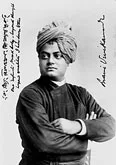
VIVEKANANDA.
InstanceEndEditable
InstanceBeginEditable name="Author Credit Bottom"
- www.vivekananda.net edited by Frank Parlato Jr.
InstanceEndEditable