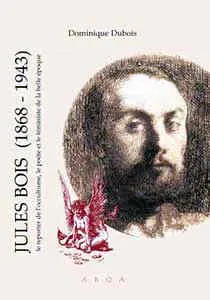
Henri Antoine Jules-Bois
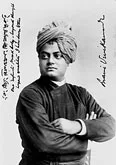
More information on their journey together can be found in Memoirs of European Travels Part II
The well-known writer and "Satanist" was a friend of Vivekananda's.
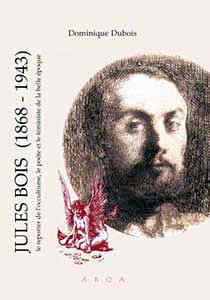 The Swami stayed with him at his house in Paris and traveled with him and Emma Calve to Egypt. Bois later saw the Swami in India.
The Swami wrote to Sister Christine (Greenstidel) on October 14th, "I am staying with a famous French writer, M. Jules Bois. I am his guest. As he is a man making his living with his pen, he is not rich; but we have many great ideas in common and feel happy together.
He discovered me a few years ago and has already translated some of my pamphlets into French. We shall in the end find what we are looking for, isn't it?
Thus, I shall travel with Madame Calve, Miss MacLeod, and M. Jules Bois. I shall be the guest of Madame Calve, the famous singer. We shall go to Constantinople, the Near East, Greece, and Egypt. On our way back, we shall visit Venice...."
In Vivekananda's Memoirs of European Travel he mentions Bois:
I have three travelling companions — two of them French and the third an American. The American is Miss MacLeod whom you know very well; the French male companion is Monsieur Jules Bois, a famous philosopher and litterateur of France; and the French lady friend is the world-renowned singer, Mademoiselle Calvé. "Mister" is "Monsieur" in the French language, and "Miss" is "Mademoiselle" — with a Z-sound.
....Monsieur Jules Bois is a famous writer; he is particularly an adept in the discovery of historical truths in the different religions and superstitions. He has written a famous book putting into historical form the devil-worship, sorcery, necromancy, incantation, and such other rites that were in vogue in Mediaeval Europe, and the traces of those that obtain to this day. He is a good poet, and is an advocate of the Indian Vedantic ideas that have crept into the great French poets, such as Victor Hugo and Lamartine and others, and the great German poets, such as Goethe, Schiller, and the rest. ....M. Jules Bois is very modest and gentle, and though a man of ordinary means, he very cordially received me as a guest into his house in Paris. Now he is accompanying us for travel."
Jules-Bois was famous or rather notorious at the time. His' Le Satanisme et la Magie, which has been described as an historical treatise on "Satanism and Magic, (1895) and was placed in the Catholic Church's index of prohibited books " .
It was rumoured that Bois was involved with another of the Swami's friends, Emma Calve, as her paramour.
Jules-Bois seems quite a colorful character who it is reported engaged in a "Magical war" and challenged opponents to pistol and saber duels in the late 1880's, both employing black magic to aid him and fearing sinister forces working against him. He was niether hurt by, nor apparently seriously hurt his opponents.
Henri Antoine Jules-Bois was born in Marseilles, France, in 1869 and educated there at the College of St. Ignatius at Aix-en- Provence and Montpelier where he received his A.B. and B.Sc. He later attended the College de France where he was granted Litt.D. At the Sorbonne he studied under Dr. Berillon and received the degree of Doctor Psychology for his researches in the field of the "superconscious."
He wrote dramas, novels, poetry, essays and scholarly papers on psychology and trends of thought. He initially wrote symbolic plays in verse, and then based several novels on women's emancipation in the 1890's such as "The Eternal Doll", "The New Era", "Restless Womanhood", "The New Sorrow and The Future Couple".
His interest in preternatural manifestations in man prompted "Mysteries of Evil" and "Lesser Religions of Paris".
At the close of the century Jules-Bois travelled to the Near and Far East, to Greece, Turkey, Egypt, Syria, Palestine and India. He became the friend of Venizelos and of Vivekananda and met Rabindranath Tagore. His Visions of India describes his search for the truth in Indian philosophy.
While in Rome in 1902 he had a private audience with Leo XIII, which he described as one of the great moments of his life. In Paris he became active in the Astronomical Society, the Society for Psychological Research of Paris, of which he was later president, and the Institute of Psychophysiology, where he spent many hours in the clinics. At the School of Psychology he later held the chair of head professor of the superconscious. In 1903 he wrote of occultism, spiritism and theosophy in The Invisible World.
In 1904 he wrote "Hyppolytus Crowned" and in 1905 "The Fury", both plays in verse adapted from antiquity. Other plays include The "Two Helens", "Nail and Leilah". Other books by Jules-Bois followed, such as "The Modern Prodigy", "The Divine in Man", "The Ship", "The Eternal Return" and "Essay on Democracy".
He died July 2, 1943, and left a partially completed manuscript for a book on, "The Psychology of Saints".
In a lecture in America Jules-Bois said, "The existence of a superconscious mind has long been recognized philosophically, being in reality the Oversoul spoken of by Emerson, but only recently has it been recognized scientifically." (quoted in the Autobiography of a Yogi, Paramhamsa Yogananda, first ed 1946)
InstanceEndEditable
InstanceBeginEditable name="Author Credit Bottom"
- www.vivekananda.net edited by Frank Parlato Jr.
InstanceEndEditable