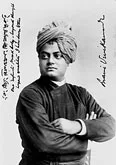
The Meeting, Tuesday Afternoon, Addressed by Suami Vive Kananda, a Learned Monk from India — Description of the Manners and Customs of His Country
The manners and customs of India
NORTH SHORE CLUB
The Meeting, Tuesday Afternoon, Addressed by Suami Vive Kananda, a Learned Monk from India — Description of the Manners and Customs of His Country
(Delivered April 17, 1894, of which there is no verbatim transcript available.)
At the meeting of the North Shore Club, Tuesday afternoon, the audience was a large and brilliant one, representing the highest culture, and including many distinguished guests. Suami Vive Kananda, from India, a learned monk, who speaks English with ease and fluency, gave an intensely interesting description of the manners and customs of his country. Suami Vive Kananda, who wore the yellow robe and turban of his order, began by saying that India is divided into two parts, the northern and the southern. In each the language and customs are so different that the speaker who was from the northern portion on meeting a fellow countryman at the Parliament of Religions from the southern, was obliged to converse with him in English, neither being able to understand the other's native language. Throughout the entire country there are nine languages and 100 dialects spoken.
There is some uniformity of religion, yet each sect is a religion and a law unto itself. Many erroneous descriptions have been written about India, based on imperfect knowledge from which inferences have been drawn that have been most prejudicial. With the Hindoo everything is subservient to religion and he gives up all that is antagonistic to it, his creed being that he is not to enjoy life but to conquer it and gain a supreme mastery over self, which is the highest type of civilization. Caste distinctions which are being obliterated are simply the Aryans and the un-Aryans — the Brahmins and the Sudras. The Brahmin, who is the child of a thousand years' culture, must lead a life of rigid discipline; but the Sudra, who is ignorant, is allowed great latitude.
Woman in the position of mother is accorded universal reverence in India. When a son who has become a monk returns to his home, his father, when greeting him, must kneel and touch his forehead to the earth; but the monk must kneel before his mother. Women in India do not throw their children into the rivers to be devoured by crocodiles. Widows are not burned on the funeral pyre of their husband unless it is a voluntary act of self-immolation.
There is no divorce allowed for the high class; a woman who leaves her husband, even if she be most degraded, holds still an interest in his property. Suami Vive Kananda recited a beautiful passage from the Legend of the Ramayana, one of the grandest poems of India, which showed what the love of a wife for her husband should be. The love of Sita for Rama. He added, “Much is said in these days of the 'survival of the fittest,'” and western nations use it as an argument against India, reasoning that their own wealth, prosperity and power show them to be greater and their religion higher and purer.
But India has seen mighty nations rise and fall whose aim has been only the power of conquest and the glory of this life. India has been repeatedly despoiled, has worn the yoke of the conqueror and borne the burden of oppression with indomitable patience and has shown tolerance to all, because she has possessed the knowledge that her people hold fast to a religion that stands securely on a high spirituality and not on the shifting sand of present enjoyment.
InstanceEndEditable
InstanceBeginEditable name="Author Credit Bottom"
- www.vivekananda.net edited by Frank Parlato Jr.
InstanceEndEditable