Newspaper and periodical reports published during Swami Vivekananda's lifetime
London, 1896
India's missionary mission to England
(From the Complete Works)
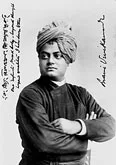
. . . I presume that in his own country the Swami would live under a tree, or at most in the precincts of a temple, his head shaved, dressed in the costume of his country. But these things are not done in London, so that I found the Swami located much like other people, and, save that he wears a long coat of a dark orange shade, dressed like other mortals likewise. He laughingly related that his dress, especially when he wears a turban, does not commend itself to the London street arab, whose observations are scarcely worth repeating. I began by asking the Indian Yogi to spell his name very slowly. . . .
"Do you think that nowadays people are laying much stress on the non-essential?"
"I think so among the backward nations, and among the less cultured portion of the civilised people of the West. Your question implies that among the cultured and the wealthy, matters are on a different footing. So they are; the wealthy are either immersed in the enjoyment of health or grubbing for more. They, and a large section of the busy people, say of religion that it is rot, stuff, nonsense, and they honestly think so The only religion that is fashionable is patriotism and Mrs. Grundy. People merely go to church when they are marrying or burying somebody."
"Will your message take them oftener to church?"
"I scarcely think it will. Since I have nothing whatever to do with ritual or dogma; my mission is to show that religion is everything and in everything. . . . And what can we say of the system here in England? Everything goes to show that Socialism or some form of rule by the people, call it what you w ill, is coming on the boards. The people will certainly want the satisfaction of their material needs, less work, no oppression, no war, more food. What guarantee have we that this or any civilisation will last, unless it is based on religion, on the goodness of man? Depend on it, religion goes to the root of the matter. If it is right, all is right."
"It must be difficult to get the essential, the metaphysical, part of religion into the minds of the people. It is remote from their thoughts and manner of life."
"In all religions we travel from a lesser to a higher truth, never from error to truth. There is a Oneness. behind all creation, but minds are very various. 'That which exists is One, sages call It variously.' What I mean is that one progresses from a smaller to a greater truth. The worst religions are only bad readings of the froth. One gets to understand bit by bit. Even devil-worship is but a perverted reading of the ever-true and immutable Brahman. Other phases have more or less of the truth in them. No form of religion possesses it entirely."
"May one ask if you originated this religion you have come to preach to England?"
"Certainly not. I am a pupil of a great Indian sage, Ramakrishna Paramahamsa. He was not what one might call a very learned man, as some of our sages are, but a very holy one, deeply imbued with the spirit of the Vedanta philosophy. When I say philosophy, I hardly know whether I ought not to say religion, for it is really both. You must read Professor Max Müller's account of my Master in a recent number of the Nineteenth Century. Ramakrishna was born in the Hooghly district in 1836 and died in 1886. He produced a deep effect on the life of Keshab Chandra Sen and others. By discipline of the body and subduing of the mind he obtained a wonderful insight into the spiritual world. His face was distinguished by a childlike tenderness, profound humility, and remarkable sweetness of expression. No one could look upon it unmoved."
"Then your teaching is derived from the Vedas?"
"Yes, Vedanta means the end of the Vedas, the third section or Upanishads, containing the ripened ideas which we find more as germs in the earlier portion. The most ancient portion of the Vedas is the Samhitâ, which is in very archaic Sanskrit, only to be understood by the aid of a very old dictionary, the Nirukta of Yâska."
"I fear that we English have rather the idea that India has much to learn from us; the average man is pretty ignorant as to what may be learnt from India."
"That is so, but the world of scholars know well how much is to be learnt and how important the lesson. You would not find Max Müller, Monier Williams, Sir William Hunter, or German Oriental scholars making light of Indian abstract science."
. . . The Swami gives his lecture at 39 Victoria Street. All are made welcome, and as in ancient apostolic times, the new teaching is without money and without price. The Indian missionary is a mall of exceptionally fine physique; his command of English can only be described as perfect.
C. S. B.
InstanceEndEditable
InstanceBeginEditable name="Author Credit Bottom"
- www.vivekananda.net edited by Frank Parlato Jr.
InstanceEndEditable