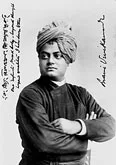
Lectures on Hindoo Religion and Philosophy
December 9, 1899
Swami Vivekananda
. . The well-known expositor of the Hindoo philosophy, dressed in the yellow robe of the Brahmin caste, spoke in part as follows:
I come before you, ladies and gentlemen, to bring no new religion. I desire simply to tell you a few points that bind together all religions. I shall touch upon some things in the thought of eastern civilization that will appear strange to you and on others that I hope will appeal to you. All the religions of the world have a backbone of unity. This is the principle of philosophy and of toleration.
Very few people in this country understand what India is. It is a country half as large as the United States and containing 300,000,000 people, speaking a number of different tongues, but all bound together by the ideas of a common religion. By these ideas the Hindoos have made their influence felt through the ages, working gently, silently, patiently, while western civilization has been conquering by force of arms. The future will show which is the more powerful — physical force or the power of ideas. The arts and sciences of the Hindoos have found their way over all the earth — their numerals, their mathematical thought, their ethics. Was it not in India, there and there alone, that the doctrine of love was first preached, and not alone the doctrine of love of one's fellow-men, but of love of every living thing, yea, even of the meanest worm that crawls under our feet. When you begin to study the arts and institutions of India, you become magnetized, fascinated. You cannot get away.
In India, as elsewhere, we find the earliest condition one of division into little tribes. These different tribes had each its different god, its different ceremonial. But in coming in contact with one another, the tribes did not follow the course that western civilization has taken — they did not persecute each other because of these differences, but endeavored to find the germs of common ideas in all the religions. And from this endeavor arose the habit of toleration which is the keynote of the Indian religion. Truth is one, can be but one, though it may be expressed in different language.
Another great difference between eastern and western religion lies in the reception of a philosophical and scientific view of the universe. In the West, agnosticism has been growing in late years, and with the loss of a hope in individual immortality, which the westerner is always desiring and seeking, a note of despair has crept into western thought. Ages ago, the Hindoo realized that the universe was one of law, and that, under law, all change. Therefore, an imperishable individuality is an impossibility. But this thought is not one of despair to the Hindoo. On the contrary — and this is what the westerner can least understand of eastern thought — he longs for freedom, for release from the thralldom of the senses, from the thralldom of pain and the thralldom of pleasure.
Western civilization has sought a personal God and despaired at the loss of belief in such. The Hindoo, too, has sought. But God cannot be known to the external senses. The Infinite, the Absolute, cannot be grasped. Yet although it eludes us, we may not infer its non-existence. It exists. What is it that cannot be seen by the outward eye? The eye itself. It may behold all other things, but itself it cannot mirror. This, then, is the solution. If God may not be found by the outer senses, turn your eye inward and find, in yourself, the soul of all souls. Man himself is the All. I cannot know the fundamental reality, because I am that fundamental reality. There is no duality. This is the solution of all questions of metaphysics and ethics. Western civilization has in vain endeavored to find a reason for altruism. Here it is. I am my brother, and his pain is mine. I cannot injure him without injuring myself, or do ill to other beings without bringing that ill upon my own soul. When I have realized that I myself am the Absolute, for me there is no more death nor life nor pain nor pleasure, nor caste nor sex. How can that which is absolute die or be born? The pages of nature are turned before us like the pages of a book, and we think that we ourselves are turning, while in reality we remain ever the same.
InstanceEndEditable
InstanceBeginEditable name="Author Credit Bottom"
- www.vivekananda.net edited by Frank Parlato Jr.
InstanceEndEditable