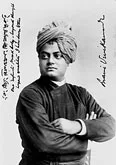
Lecture last night at Blanchard Hall by
January 03, 1900
Told about India
Lecture last night at Blanchard Hall by Swami Vivekananda
Swami Vivekananda, member of an ancient order of Hindu monks, who is giving a series of lessons and lectures in this city, addressed an audience last night at Blanchard hall upon the "History of India" ["The People of India"]. (Of which no verbatim transcript is available.) The Swami appeared before his audience in American dress, losing to a great degree the peculiar and characteristic personality given him by the aesthetic silken robes and the turban worn by his order.
The speaker said India was not a country, but a continent containing a huge mass of races united by religion. India was of ancient date. It was inhabited, when through a desire to reach it by a shorter passage, Columbus discovered America, and its production of cotton, sugar, indigo and spices have enriched the world. This country inhabited by 200,000,000 of people, is full of little villages that extend through all the valleys and up the mountains thousands of feet above the sea level. The immense fertility of the soil owes much to the tremendous rainfall, which is often 1,800 inches [sic] in a season, averaging perhaps 600 inches. Many of the people, however, in spite of the abundant productions, live wholly on millet, a kind of cereal; no animal food is eaten; no meat, eggs or fish.
The country from most ancient times has kept its own customs, its own languages and its castes. It has by its religion saved itself while it has seen other sections [nations] rise and decay. The Babylonian civilization was not new, but India dates long before its rise and fall. The most ancient language, Sanskrit, is spoken by the priests, and was spoken once by all the different races. The speaker gave examples of many of our common English words coming from Sanskrit roots, and traced the old religious ideas and even mythology to the ancient Aryan races.
Many of the customs of the country were sketched, and further it was shown how this country was the seat of civilization, the center of arts, the sciences, the philosophical thought of the world.
The people of India have saved themselves by making a wall around themselves by making the castes absolute. An emperor in India is glad to trace his descent from a priest, who is the highest caste. The castes do not exist as they did once, but they are divided into many divisions and sub-divisions. There are hundreds of them. No people of different castes eat together, or cook together. Marriage is not legal if made outside of one's caste. The intricacy of the laws of caste is very great and branch out into the minutest detail. The poorest beggar or the viceroy of India may belong to the same caste.
Shoes are not allowed to be worn, as they are made from the skin of an animal. The women pay even more attention to these details than the men. All these customs have their philosophy. This is the true democracy, it is the socialistic idea, the development of the masses, not the individual.
The speaker closed with comparing the position of women in India with that of this country. In India the whole idea of womanhood is the mother. The mother is reverenced. She is the giver of life, the founder of the race.
InstanceEndEditable
InstanceBeginEditable name="Author Credit Bottom"
- www.vivekananda.net edited by Frank Parlato Jr.
InstanceEndEditable