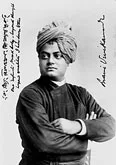
Newspaper and periodical reports published during Swami Vivekananda's lifetime
February 27, 1895
India's Gift to the World
Swami Vivekananda, the Hindoo monk, delivered a lecture Monday night under the auspices of the Brooklyn Ethical Association before a fairly large audience at the hall of the Long Island Historical Society, corner Pierrepont and Clinton streets. His subject was "India's Gift to the World".
He spoke of the wondrous beauties of his native land, "where stood the earliest cradle of ethics, arts, sciences, and literature, and the integrity of whose sons and the virtue of whose daughters have been sung by all travelers." Then the lecturer showed in rapid details, what India has given to the world.
"In religion," he said, "she has exerted a great influence on Christianity, as the very teachings of Christ would [could] be traced back to those of Buddha." He showed by quotations from the works of European and American scientists the many points of similarity between Buddha and Christ. The latter's birth, his seclusion from the world, the number of his apostles, and the very ethics of his teachings are the same as those of Buddha, living many hundred years before him.
"Is it mere chance," the lecturer asked, "or was Buddha's religion but the foreshadowing of that of Christ? The majority of your thinkers seem to be satisfied in the latter explanation, but there are some bold enough to say that Christianity is the direct offspring of Buddhism just as the earliest heresy in the Christian religion — the Monecian [Manichaean] heresy — is now universally regarded as the teaching of a sect of Buddhists. But there is more evidence that Christianity is founded in Buddhism. We find it in recently discovered inscriptions from the reign of Emperor Oshoka [Asoka] of India, about 300 B.C., who made treaties with all the Grecian kings, and whose missionaries discriminated [disseminated ?] in those very parts, where, centuries after, Christianity flourished, the principles of the Buddhistic religion. Thus it is explained, why you have our doctrine of trinity, of incarnation of God, and of our ethics, and why the service in our temples is so much alike to that in your present Catholic churches, from the mass to the chant and benediction. Buddhism had all these long before you. Now use your own judgment on these premise — we Hindoos stand ready to be convinced that yours is the earlier religion, although we had ours some three hundred years before yours was even thought of.
"The same holds good with respect to sciences. India has given to antiquity the earliest scientifical physicians, and, according to Sir William Hunter, she has even contributed to modern medical science by the discovery of various chemicals and by teaching you how to reform misshapen ears and noses. Even more it has done in mathematics, for algebra, geometry, astronomy, and the triumph of modern science — mixed mathematics — were all invented in India, just so much as the ten numerals, the very cornerstone of all present civilization, were discovered in India, and are in reality, Sanskrit words.
"In philosophy we are even now head and shoulders above any other nation, as Schopenhauer, the great German philosopher, has confessed. In music India gave to the world her system of notation, with the seven cardinal notes and the diatonic scale, all of which we enjoyed as early as 350 B.C., while it came to Europe only in the eleventh century. In philology, our Sanskrit language is now universally acknowledged to be the foundation of all European languages, which, in fact, are nothing but jargonized Sanskrit.
"In literature, our epics and poems and dramas rank as high as those of any language; our 'Shaguntala' [Shakuntala] was summarized by Germany's greatest poet, as 'heaven and earth united'. India has given to the world the fables of Aesop, which were copied by Aesop from an old Sanskrit book; it has given the Arabian Nights, yes, even the story of Cinderella and the Bean Stalks. In manufacture, India was the first to make cotton and purple [dye], it was proficient in all works of jewelry, and the very word 'sugar', as well as the article itself, is the product of India. Lastly she has invented the game of chess and the cards and the dice. So great, in fact, was the superiority of India in every respect, that it drew to her borders the hungry cohorts of Europe, and thereby indirectly brought about the discovery of America.
"And now, what has the world given to India in return for all that? Nothing but nullification [vilification] and curse and contempt. The world waded in her children's life-blood, it reduced India to poverty and her sons and daughters to slavery, and now it adds insult to injury by preaching to her a religion which can only thrive on the destruction of every other religion. But India is not afraid. It does not beg for mercy at the hands of any nation. Our only fault is that we cannot: fight to conquer; but we trust in the eternity of truth. India's message to the world is first of all, her blessing; she is returning good for the evil which is done her, and thus she puts into execution this noble idea, which had its origin in India. Lastly, India's message is, that calm goodness, patience and gentleness will ultimately triumph. For where are the Greeks, the onetime masters of the earth? They are gone. Where are the Romans, at the tramp of whose cohorts the world trembled? Passed away. Where are the Arabs, who in fifty years had carried their banners from the Atlantic to the Pacific? and where are the Spaniards, the cruel murderers of millions of men? Both races are nearly extinct; but thanks to the morality of her children, the kinder race will never perish, and she will yet see the hour of her triumph."
At the close of the lecture, which was warmly applauded, Swami Vivekananda answered a number of questions in regard to the customs of India. He denied positively the truth of the statement published in yesterday's [February 25] Standard Union, to the effect that widows are ill-treated in India. The law guarantees her not only her own property, before marriage, but also all she received from her husband, at whose death, if there be no direct heirs, the property goes to her. Widows seldom marry in India, because of the scarcity of men. He also stated that the self-sacrifices of wives at the death of their husbands as well as the fanatical self-destruction under the wheels of the Juggernaut, have wholly stopped, and referred his hearers for proof to Sir William Hunter's "History of the Indian Empire".
InstanceEndEditable
InstanceBeginEditable name="Author Credit Bottom"
- www.vivekananda.net edited by Frank Parlato Jr.
InstanceEndEditable