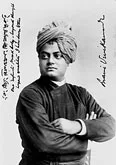
Newspaper and periodical reports published during Swami Vivekananda's lifetime
October 23, 1895
An Indian Ascetic
Since the days of Ramahoun Roy, says the Standard, with the single exception of Keshub Chunder Sen, there has not appeared on an English platform a more interesting Indian figure than the Brahman who lectured in Princes' Hall last night. . . .
The lecture was a most fearless and eloquent exposition of the pantheistic philosophy of the Vedanta school, and the Swami seems to have incorporated into his system a good deal also of the moral element of the Yoga school, as the closing passage of his lecture presented in a modified form not the advocacy of mortification, which is the leading feature of the latter school, but the renunciation of all so-called material comforts and blessings, as the only means of entering into perfect union with the supreme and absolute Self. The opening passages of the lecture were a review of the rise of the grosser form of Materialism in the beginning of the present century, and the later development of the various forms of metaphysical thought, which for a time swept materialism away. From this he passed on to discuss the origin and nature of knowledge. In some respects his views on this point were almost a statement of pure Fichteism, but they were expressed in language, and they embodied illustrations, and made admissions which no German transcendentalist would have used. He admitted there was a gross material world outside, but he confessed he did not know what matter was. He asserted that mind was a finer matter, and that behind was the soul of man, which was immovable, fixed, before which outward objects passed, as it were, in a procession, which was without beginning or end — in other words, which was eternal, and finally which was God. He worked out this pantheistic conception of the personal identity of man and God with great comprehensiveness and an ample wealth of illustration, and in passage after passage of great beauty, solemnity, and earnestness. "There is only one Soul in the Universe", he said:
There is no "you" or "me"; all variety is merged into the absolute unity, the one infinite existence — God.
From this, of course, followed the immortality of the soul, and something like the transmigration of souls towards higher manifestations of perfection. As already stated, his peroration of twenty minutes was a statement of the doctrine of renunciation. In the course of it he made some remorselessly disparaging criticism on the work that factories, engines and other inventions, and books were doing for man, compared with half a dozen words spoken by Buddha or Jesus. The lecture was evidently quite extemporaneous, and was delivered in a pleasing voice, free from any kind of hesitation.
InstanceEndEditable
InstanceBeginEditable name="Author Credit Bottom"
- www.vivekananda.net edited by Frank Parlato Jr.
InstanceEndEditable