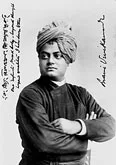
Newspaper and periodical reports published during Swami Vivekananda's lifetime
May 17, 1894
The religions of India
The Brahmin monk, Swami Vivekananda, lectured yesterday afternoon in Association Hall on "The Religions of India", in aid of the Ward 16 Day Nursery. There was a large attendance.
The speaker first gave an account of the Mahommedans, who formed, he said, one-fifth of the population. They believed in both Old and New Testaments, but Jesus Christ they regarded only as a prophet. They had no church organization, though there was reading of the Koran.
The Parsees, another race, called their sacred book the Zend-Avesta, and believed in two warring deities, Armuzd the good and Ahriman the evil. They believed that finally the good would triumph over the evil. Their moral code was summed up in the words: "Good thought, good words, good deeds."
The Hindus proper looked up to the Vedas as their religious scripture. They held each individual to the customs of caste, but gave him full liberty to think for himself in religious matters. A part of their method was to seek out some holy man or prophet in order to take advantage of the spiritual current that flowed through him.
The Hindus had three different schools of religion — the dualistic, the qualified monistic and the monistic — and these three were regarded as stages through which each individual naturally passed in the course of his religious development.
All three believed in God, but the dualistic school believed that God and man were separate entities, while the monistic declared that there was only one existence in the universe, this unitary existence teeing neither God nor soul, but something beyond.
The lecturer quoted from the Vedas to show the character of the Hindu religion, and declared that, to find God, one must search one's own heart.
Religion did not consist of pamphlets or books; it consisted of looking into the human heart, and finding there the truths of God and immortality. "Whomsoever I like," said the Vedas, "him I create a prophet," and to be a prophet was all there was of religion.
The speaker brought his lecture to a close by giving an account of the Jains, who show remarkable kindness to dumb animals, and whose moral law is summed up in the words: "Not to injure others is the highest good."
InstanceEndEditable
InstanceBeginEditable name="Author Credit Bottom"
- www.vivekananda.net edited by Frank Parlato Jr.
InstanceEndEditable