Newspaper and periodical reports published during Swami Vivekananda's lifetime
January 17, 1894
Plea for tolerance
An audience of fair proportions gathered last night at the Auditorium to greet the celebrated Hindu monk. Swami Vive Kananda, in his lecture on Hinduism.
He was introduced in a brief but informing address by Judge R. J. Morgan, who gave a sketch of the development of the great Aryan race, from which development have come the Europeans and the Hindus alike, so tracing a racial kinship between the people of America and the speaker who was to address them.
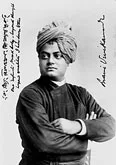
The eminent Oriental was received with liberal applause, and heard with attentive interest throughout. He is a man of fine physical presence, with regular bronze features and form of fine proportions. He wore a robe of pink silk, fastened at the waist with a black sash, black trousers and about his head was gracefully draped a turban of yellow India silk. His delivery is very good, his use of English being perfect as regards choice of words and correctness of grammar and construction. The only inaccuracy of pronunciation is in the accenting of words at times upon a wrong syllable. Attentive listeners, however, probably lost few words, and their attention was well rewarded by an address full of original thought, information and broad wisdom. The address might fitly be called a plea for universal tolerance, illustrated by remarks concerning the religion of India. This spirit, he contended, the spirit of tolerance and love, is the central inspiration of all religions which are worthy, and this, he thinks, is the end to be secured by any form of faith.
His talk concerning Hinduism was not strictly circumstantial. His attempt was rather to give an analysis of its spirit than a story of its legends or a picture of its forms. He dwelt upon only a few of the distinctive credal or ritual features of his faith, but these he explained most clearly and perspicuously. He gave a vivid account of the mystical features of Hinduism, out of which the so often misinterpreted theory of reincarnation has grown. He explained how his religion ignored the differentiations of time, how, just as all men believe in the present and the future of the soul, so the faith of Brahma believes in its past. He made it clear, too, how his faith does not believe in "original sin," but bases all effort and aspiration on the belief of the perfectibility of humanity. Improvement and purification, he contends, must be based upon hope. The development of man is a return to an original perfection. This perfection must come through the practice of holiness and love. Here he showed how his own people have practiced these qualities, how India has been a land of refuge for the oppressed, citing the instance of the welcome given by the Hindus to the Jews when Titus sacked Jerusalem and destroyed the Temple
In a graphic way he told that the Hindus do not lay much stress upon forms. Sometimes every member of the family will differ in their adherence to sects, but all will worship God by worshipping the spirit of love which is His central attribute. The Hindus, he says, hold that there is good in all religions, that all religions are embodiments of man's inspiration for holiness, and being such, all should be respected. He illustrated this by a citation from the Vedas [?], in which varied religions are symbolized as the differently formed vessels with which different men came to bring water from a spring. The forms of the vessels are many, but the water of truth is what all seek to fill their vessels with. God knows all forms of faith, he thinks, and will recognize his own name no matter what it is called, or what may be the fashion of the homage paid him.
The Hindus, he continued, worship the same God as the Christians. The Hindu trinity of Brahma, Vishnu, Siva is merely an embodiment of God the creator, the preserver and the destroyer. That the three are considered three instead of one is simply a corruption due to the fact that general humanity must have its ethics made tangible. So likewise the material images of Hindu gods are simply symbols of divine qualities.
He told, in explanation of the Hindu doctrine of incarnation, the story of Krishna, who was born by immaculate conception and the story of whom greatly resembles the story of Jesus. The teaching of Krishna, he claims, is the doctrine of love for its own sake, and he expressed [it] by the words "If the fear of the Lord is the beginning of religion, the love of God is its end."
His entire lecture cannot be sketched here, but it was a masterly appeal for brotherly love, and an eloquent defense of a beautiful faith. The conclusion was especially fine, when he acknowledged his readiness to accept Christ but must also bow to Krishna and to Buddha; and when, with a fine picture of the cruelty of civilization, he refused to hold Christ responsible for the crimes of progress.
InstanceEndEditable
InstanceBeginEditable name="Author Credit Bottom"
- www.vivekananda.net edited by Frank Parlato Jr.
InstanceEndEditable