Foreign Missions.
March 15, 1894
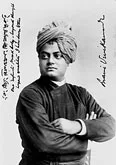
Editor Journal.-- It seems that Kananda, the Hindoo preacher, has stirred up the antagonism of many Christian ministers. At the home of Mrs. Shelden last Wednesday, the ladies of the Foreign missionary society met and listened to an address by Mr. Thackwell, a missionary from India. He contradicted Kananda's statement that it was the Hindoos who abolished the custom of burning widows in India. Who would be most likely to know best? One who has been there as a missionary, or one who was born on the banks of the Ganges, traveled all over the country and lived there all his life; a man of learning, who could have no object in making a false statement? We have been told again and again, that the overthrow of that custom was one of the blessed effects of Christian missionary work. But here comes a native missionary from India, who tells us it was the Brahmins who put a stop to the horrid custom.
We have also been taught from our early youth that Hindu mothers throw their children to crocodiles in the river Ganges. But now a man who was born on the banks of that river tells us that there was never a crocodile in the Ganges. It is possible that the Rev. Thackwell's statement that Hindu mothers strangle their own babies has no more foundation in truth. Mr. Thackwell says it was the English government that abolished the custom of burning widows in India. But we all know how ready Christian England is to credit herself with any good done, or evil overthrown in her provinces. If England put a stop to that wicked custom, it must have been because she could make no money out of it. She sends out shiploads of liquor with agents to distribute and sell it. She could gain more dollars by making widows through the liquor traffic. India did not want her liquor any more than the Chinese wanted her opium, but she Forced the opium trade on China at the mouth of the cannon, and her liquor trade through distributing agents in India. England is a field greatly in need of missionary work and the foreign missionary society ought not to pass it by.
It costs on an average twenty-five to thirty thousand dollars a head for every heathen convert made. This is very expensive and we do not wonder that every available means are resorted to for the purpose of raising money. Collections of pennies from Sabbath school children, and missionary collections in churches, after listening to a sermon in which the sad condition of the poor heathens who strangle their babes and feed the crocodiles with their children are pictured and the sympathies of the audience are aroused. Dr. Gordon, a member of a church in Boston and an officer of the Foreign Missionary Society, tells us how they manage to raise money. They pray every day for a month and then take up a $20,000 collection. He boasts that by this means they get from poor servant girls $50, and from one poor old lady living in a tenement house, who only had a thousand dollars to live on all the rest of her days, they managed to get $800--see the Journal of March 6. Now if there is a spot on God's green earth where missionary work is most needed, it must be Dr. Gordon's church in Boston.
The means employed to obtain this money might be prayer, sympathy, hypnotism or the muzzle of a revolver. In a moral point of view it is equally wrong and no more justified than highway robbery. It is at home where true Christian missionary work is most needed, not only in the slums of our cities, but among the 400 in Boston, Chicago and New York; not only among our heathen Indians, who have been robbed and destroyed by American Christians, but many of the professed Christian churches of this land need to be taught the first principles of a true Christianity, justice, righteousness and brotherly love.
J. STEELE.
InstanceEndEditable
InstanceBeginEditable name="Author Credit Bottom"
- www.vivekananda.net edited by Frank Parlato Jr.
InstanceEndEditable