Newspaper and periodical reports published during Swami Vivekananda's lifetime
Friday, December 15, 1893
The manners and customs of India
Swami Vive Kananda, the Brahmin priest, was greeted by a packed house last evening at the First Unitarian Church, when he appeared before his second Minneapolis audience. Vive Kananda is a bright, quick witted talker, ready at all points to attack or defend, and inserts a humor into his speeches that is not lost upon his auditors. He spoke last evening under the auspices of the Kappa Kappa Gammas of the University, and the audience embraced a large number of earnest thinking men and women, pleased to be enlightened upon the "Manners and Customs of India," which was his chosen subject. (See also "A witty Hindu" for other highlights of the lecture.)
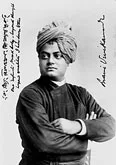
Robed in his native garb, with his hands for the most part clasped behind his back, Kananda paces back and forth the narrow platform, talking as he paces, with long pauses between his sentences, as if willing that his words should sink into the deepest soil. His talk is not so weighty that the frivolous mind may not appreciate some of his sayings, but he also speaks a philosophy that carries gravest truth. He tells of the manners and customs of India, of the divided life between the male and female, of the reverence for and holiness of women, and again of their degeneracy; of the calm and peaceful life, that yet is not true life because it is not liberty; he speaks of the Mohammedans, who form one-fifth of the Indian population, and that 65,000,000, equal to the entire population of the United States. He describes the magnificence of the temples, the art of the jugglers, who are the gypsies of the Indian race, and he touches upon the superstitions of the people, of how they fill the water jars and stand them in the doorway before starting on a journey; he speaks of the metaphysical knowledge of the plowman, who yet only knows that he "pays taxes to the government"; he admits the reverence of the Hindu for the river Ganges, and his ever lingering wish that he shall die on its banks; he tells all these things in a quiet, half supercilious voice that presently leads to some remark on the American way of doing things, and then his audience is in a ripple of laughter, and a tremor of clapping expresses amused acknowledgement of his sarcasm. . . .
When some one at the close of his lecture asked him "What class of people are reached and converted by the missionaries?" he quickly replied, "You know as much about that, the American sees the reports, we never do", he has turned the query into a cause for smiling, and while the house regains its composure he paces quietly to and fro. The address was followed with the closest attention and was supplemented by several questions and answers among the audience, from whom he invited interrogation.
InstanceEndEditable
InstanceBeginEditable name="Author Credit Bottom"
- www.vivekananda.net edited by Frank Parlato Jr.
InstanceEndEditable