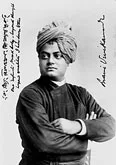
Swami Vivekananda's lecture before the Academy of
December 13, 1899
Conception of the Universe
Swami Vivekananda's lecture before the Academy ofSciences
Unity church was filled last evening with a large audience to hear the Swami Vivekananda, a native of India, lecture on the kosmos, or the Veda conception of the universe under the auspices of the Southern California Academy of Sciences. . . .
In introducing his subject the speaker reviewed the mythology of the flood, which among the Babylonians, Egyptians, Assyrians and other races is similar to the story of the Hebrew scriptures, showing that all held a similar belief concerning the creation of the universe.
In the worship of the sun and the forces of nature, we see the attempts of ancient peoples to explain the mysteries surrounding them. Man's first idea of force was himself. When a stone fell he saw no force in it but the will behind it, and he conceived the idea that the whole universe was moved by force of wills. Gradually these wills became one, and science begins to rise. Gods begin to vanish, and in their place comes oneness, and now God is in danger of being dethroned by modern science. Science wants to explain things by their own nature and make the universe self-sufficient.
Wills gradually began to disappear, and in their place comes will. This was the process of development in all the nations of the world, and so it was in India. Their ideas and gods were pretty much the same as those of other lands, only in India they did not stop there. They learned that life alone can produce life, and that death can never produce life. In our speculations about God we have got to monotheism. Everywhere else speculation stops there; we make it the be all and end all of everything, but in India it does not stop there. A gigantic will can not explain all this phenomena we see around us. Even in man there is something back of the will. In so common sense a thing as the circulation of the blood, we find will is not the motive power.
We have conceived God as a person like ourselves, only infinitely greater, and because there is goodness and mercy and happiness in the world there must be a being possessing these attributes, but there is also evil. The Hindu mind is too philosophical to admit the existence of two gods, one good and one bad. India remained true to the idea of unity. What is evil to me may be good to someone else; what is good to me may be evil to others. We are all links in a chain. Hence comes the speculation of the Upanishads, the religion of 300,000,000 of the human race. Nature is a unit; unity is in all existence, and God is the same as nature. This is one of the Indian speculations known to all the world outside of India.
There is not a system of religion or philosophy in the world that does not show the influence of India's speculation, even to the Catholic church. The conservation of energy, considered a new discovery, has been known there by the name of father [Prâna?]. Whatever is comes from the father. Brahma [Prana?] must energize on something, and that they say is an invisible ether. Brahma [Prana?] vibrating on ether, the solid, the liquid, the luminous, it is all the same ether. The potentiality of everything is there. In the beginning of the next period Brahma [Prana?] will begin to vibrate more and more.
Thus this speculation of India's scriptures is very similar to modern science. The same idea is taken up by modern evolution. Even our bodies, different only in dignity, are links in the same chain. In one individual the possibilities of every other individual are there. The living entity contains the possibility of all life, but can only express that which environment demands. The most wonderful speculations are formed in modern science. The one that interests me as a preacher of religion is the oneness of all religions [life?]. When Herbert Spencer's voice says that the same life welling up in the plant is the life welling up in the individual, the Indian religion has found a voice in the nineteenth century.
InstanceEndEditable
InstanceBeginEditable name="Author Credit Bottom"
- www.vivekananda.net edited by Frank Parlato Jr.
InstanceEndEditable