Not a Hindoo.
Newspaper article
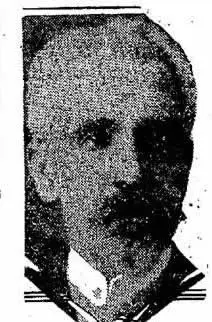
Swami Kripananda
(aka Leon Landsberg)
The Ogden Standard - Examiner
Monday, May 24, 1920
TRY THIS, AND IF YOU DON'T GO INSANE YOU MAY LIVE FOREVER
BY JAMES HENLE.
N E. A. Staff Correspondent.
NEW YORK, May 22.—Is the human race about to abolish death? Can present-daymorta. Is obtain. immortal life?
Most religious say not. Science says no. Common sense says no.
Death can be abolished, asserts Swami Kripananda. It is within man's power to fix the limit of his own life, or to abolish that limit entirely, if he desires. There are men living today in India, he says, who have been alive for several hundred years and who can continue their lives indefinitely.
Swami Kripananda is not a Hindoo though he goes by the Hindoo name which became his when he was initiated into  his sect. He is of French-Russian extraction and has been a citizen of the United States for 40 years. He lives today in Brooklyn.
How can death be abolished? Swami Kripananda answers:
"The task before us is to obtain direction. over what we have been doing involuntarily—over our thoughts, our heart-beats, our breath. As soon as we do that we shall be able to control our bodies, and then we shall have neither disease nor senility, neither birth nor death.
"The heart-beat controls the brain and our breath controls our heart: beat. So we see that if we are able to direct our breathing we shall control our heart-beats and through those our brains.
Follow These Steps.
"In order to reach the superconsciousness which he seeks, one must go through the following steps:
Yama or the state of harmlessness, Chastity, truthfulness, honesty and not desiring gifts from others.
Study of the scriptures, bodily and mental purity, tranquility of mind, austerities and the worship of God.
Asanas, or various postures which enable one to perfect his body.
Pranayama; or control of breath.
Pratyhara, or abstraction.
Dharana, or concentration.
Dhyana, or meditation.
"It is through the Asanas and Pranayama that death can be abolished.
"The study should not be begun except under the instruction of a competent teacher. Men who have tried this without intelligent guidance have gone insane.
"Some philosophers say there are 84 different asanas. Others say there are as many as a million. The object of them all is to strengthen the body and at the same time to free the mind for its tasks by rejecting and excluding all outside influences.
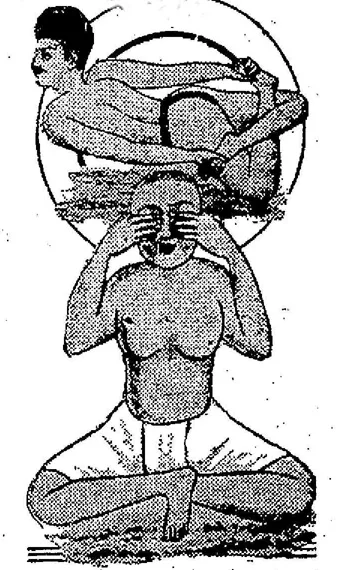
Swami Kripananda and his illustrations showing how to apply the "asanas" and the "dharana." Upper is a posture to perfect one's body. Lower shows the rubbing of eyes and ears to aid in concentration.
"Beautiful Voices"
"If you try one of the asanas, you will be surprised to find how calm your nerves become, no matter how much you have been wrought up. Your face will change, the harsh lines will disappear it will become serene. Next you will hear beautiful voices. These signs come after only a few months practice.
“In practicing one of the asanas it is helpful to repeat slowly and softly some word, as it aids you in fixing your attention. The word usually chosen is 'om,' which is the Hindoo, word to express "divinity"
InstanceEndEditable
InstanceBeginEditable name="Author Credit Bottom"
- www.vivekananda.net edited by Frank Parlato Jr.
InstanceEndEditable