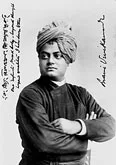
Aphorisms and Maxims of Swami Vivekananda

Aphorisms & Maxims

Presented below are a number of short philosophic and moral precepts culled from Swami Vivekananda's works and utterances. Some will also be found in the section on quotations as part of a particular quotation and again in his teachings. In this section, we have attempted to choose statements of force and brevity - which stand alone as, perhaps, a complete lesson in and of themselves.
- The whole of life is only a swan-song
- The giver of the head is alone the leader.
(meaning only he who will sacrifice his life for the cause is fit to be the leader of a cause) - Strength is the medicine for the world's disease.
- The weak have no place here, in this life or in any other life.
- Truth, purity and unselfishness -- wherever these are present, there is no power below or above the sun to crush the possessor thereof.
- To work, with undaunted energy! What fear! Who is powerful enough to thwart you!
- Strength is the property of everyone in spite of all apparent weakness.
- As soon as a man or a nation loses faith in himself, death comes.
- For ascetics, mortification is all right, for workers, well-developed bodies, muscles of iron and nerves of steel.
- You are also as much a man as the greatest of men - even an Incarnation.
(spoken June 19, 1899) - Please everyone without becoming a hypocrite or a coward
- Time, patience, and indomitable will must show.
-
Time and opportunity must come if it is to be done you know, otherwise we vainly strive.
-
In everyone is God, the Atman; all else is but dream, an illusion.
(notes of Frank Rhodehamel) -
Let your life in the world be nothing but a thinking to yourself.
-
Awake! Awake! all ye who would drink of the divine nectar!
(attributed to SV by Swami Sadananda) -
Whatever exists has a reason; find that reason.
- The constitutional belief in freedom is the basis of all reasoning.
-
The highest truth is always the simplest. (CWSN 1: 226)
-
This world is neither good nor evil; each man manufactures a world for himself.
-
Infinite faith and strength are the only conditions of success.
- The best work is only done by alternate repose and work.
(Letter to sashi march 1898) - Women deserve and are fit for everything.
- The glory of life is chastity.
- Love is always the highest ideal.
- The greatest name man ever gave to God is Truth.
- No one can get anything unless he earns it. This is an eternal law.
- The brave alone can afford to be sincere. Compare the lion and the fox.
- There is no other teacher but your own soul.
- The totality of all souls, not the human alone, is the Personal God.
- That which is bound is nature, not the soul.
- Life is but a dream of death.
- If we can find in ourself something that is not acted on by any cause, then we have known the Self.
- Concentration is the essence of all knowledge, nothing can be done without it.
- Education is the manifestation of the perfection already in man.
- Religion is the manifestation of the Divinity already in man.
- As soon as you make a sect, you protest against universal brotherhood.
- The more you fly from nature, the more she follows you; and if you do not care for her at all, she becomes your slave.
- He who has conquered the internal nature controls the whole universe; it becomes his servant.
- There is no virtue higher than non-injury.
- Chastity is the basis of all religions.
- Mercy shall not be for men alone, but shall go beyond, and embrace the whole world.
- There never was a friendship, especially of women, which was not exacting.
- Renunciation is the very basis upon which ethics stands.
- Everything is fraught with fear: Renunciation alone is fearless.
- Truth does not pay homage to any society, modern or ancient. Society has to pay homage to truth, or die.
- The Mohammedans think much of the new moon. Let us also, with the new moon, begin a new life!
- No man is born to any religion; he has a religion in his own soul.
- The real individuality is that which never changes and will never change; and that is the God within us.
- The flesh and the devil are but degrees of difference from God Himself.
- Pure love has no motive. It has nothing to gain.
- When love to God is revealed and is all, this world appears like a drop.
- When a man has reached that perfect state, he is of the same nature as the Personal God. "I and my Father are one."
- Sipâhis (sepoys) die soon — nature is full of defect — the athletes die soon.
- Purity, patience, and perseverance are the three essentials to success, and above all, love.
- The only worship is love.
- Truth never dreams.
- By truth we attain fruits of work.
- Through truth everything is attained. In truth everything is established.
- The worm that crawls under your feet today is a God to be.
- That man has reached immortality who is disturbed by nothing material.
- Each individual has to work out his own salvation; there is no other way, and so also with nations.
- The strong, the well-knit, the young, the healthy, the daring alone are fit to be Yogis.
- To the Yogi everything is bliss.
- Misery is caused by sin, and by no other cause.
- From contentment comes superlative happiness.
- Friendship with many is good at a distance.
InstanceEndEditable
InstanceBeginEditable name="Author Credit Bottom"
- www.vivekananda.net edited by Frank Parlato Jr.
InstanceEndEditable