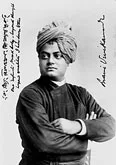
On Lord Buddha
(Delivered in Detroit )
In every religion we find one type of self-devotion particularly developed. The type of working without a motive is most highly developed in Buddhism. Do not mistake Buddhism and Brâhminism. In this country you are very apt to do so. Buddhism is one of our sects. It was founded by a great man called Gautama, who became disgusted at the eternal metaphysical discussions of his day, and the cumbrous rituals, and more especially with the caste system. Some people say that we are born to a certain state, and therefore we are superior to others who are not thus born. He was also against the tremendous priestcraft. He preached a religion in which there was no motive power, and was perfectly agnostic about metaphysics or theories about God. He was often asked if there was a God, and he answered, he did not know. When asked about right conduct, he would reply, "Do good and be good." There came five Brâhmins, who asked him to settle their discussion. One said, "Sir, my book says that God is such and such, and that this is the way to come to God." Another said, "That is wrong, for my book says such and such, and this is the way to come to God"; and so the others. He listened calmly to all of them, and then asked them one by one, "Does any one of your books say that God becomes angry, that He ever injures anyone, that He is impure?" "No, Sir, they all teach that God is pure and good." "Then, my friends, why do you not become pure and good first, that you may know what God is?"
Of course I do not endorse all his philosophy. I want a good deal of metaphysics, for myself. I entirely differ in many respects, but, because I differ, is that any reason why I should not see the beauty of the man? He was the only man who was bereft of all motive power. There were other great men who all said they were the Incarnations of God Himself, and that those who would believe in them would go to heaven. But what did Buddha say with his dying breath? "None can help you; help yourself; work out your own salvation." He said about himself, "Buddha is the name of infinite knowledge, infinite as the sky; I, Gautama, have reached that state; you will all reach that too if you struggle for it." Bereft of all motive power, he did not want to go to heaven, did not want money; he gave up his throne and everything else and went about begging his bread through the streets of India, preaching for the good of men and animals with a heart as wide as the ocean.
He was the only man who was ever ready to give up his life for animals to stop a sacrifice. He once said to a king, "If the sacrifice of a lamb helps you to go to heaven, sacrificing a man will help you better; so sacrifice me." The king was astonished. And yet this man was without any motive power. He stands as the perfection of the active type, and the very height to which he attained shows that through the power of work we can also attain to the highest spirituality.
To many the path becomes easier if they believe in God. But the life of Buddha shows that even a man who does not believe in God, has no metaphysics, belongs to no sect, and does not go to any church, or temple, and is a confessed materialist, even he can attain to the highest. We have no right to judge him. I wish I had one infinitesimal part of Buddha's heart. Buddha may or may not have believed in God; that does not matter to me. He reached the same state of perfection to which others come by Bhakti — love of God — Yoga, or Jnâna. Perfection does not come from belief or faith. Talk does not count for anything. Parrots can do that. Perfection comes through the disinterested performance of action.
InstanceEndEditable
InstanceBeginEditable name="Author Credit Bottom"
- www.vivekananda.net edited by Frank Parlato Jr.
InstanceEndEditable