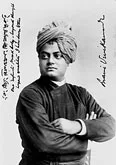
Datta Ancestral Home - Birthplace of Vivekananda
Government of India
Author: Srijata Saha Sahoo
Publication: Press Information Bureau
Date: October 1, 2004
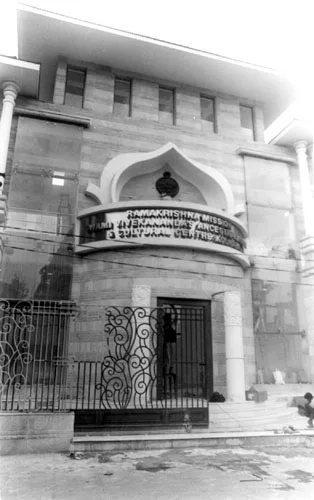
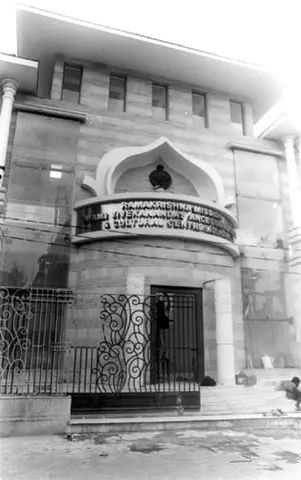
Kolkata has added another glory to its cultural heritage. Just before the 'Puja', the renovated ancestral home of Swami Vivekananda at 3, Gourmohan Mukherjee Street , in North Kolkata , was opened to the public amidst much fervour and devotion and the cultural centre adjoining has been formally inaugurated by the President of India, Shri A.P. J. Abdul Kalam.
It took nearly five years to complete the restoration work of Swamiji' ancestral home, though the decision of turning it to a memorial-cum-museum was taken in 1962. The edifice standing on 30 cottahs of land along with the newly constructed research and cultural center, the textbook library and the social and philanthropy building would soon turn into a notable site like Belur Math. According to Swami Bishokananda, who was in the charge of this project, the President has not only inaugurated the research-cum-cultural centre, he has also formally opened the textbook library meant for students of Higher Secondary and those who are pursuing graduate and post-graduate studies.
The 18th century building was in a dilapidated condition, worsening day by day. The Ramkrishna Mission acquired it, along with an adjacent plot, in May 1999 through State government. A committee was set up- comprising, among others, conservation engineers of Archaeological Survey of India sto advise on the renovation and coordinate with the agencies involved in the process.
The Centre, the State government as well as public donation to Ramakrishna Mission, funded the Rs. 20 crore restoration project in which the Central grant was Rs. 9 crore 90 lakh.
Ramakrishna Mission restored Swamiji's ancestral house without changing any of its original architectural features. It houses Swamiji's birthplace, meditation hall (first floor) and museum, where some of the articles used by Swamiji, his father, mother and brothers are preserved.
Swamiji was born in this house on January 12, 1863 as the eldest son, Narendranath, of Viswanath Dutta and Bhubaneswari Devi. His great grandfather Rammohan Dutta originally built the house.
During Swamiji's time, the house was surrounded by a garden and beyond that there was a large open space. But in later years, owing to the city's growth and its ever increasing buildings, the approach road to the house got narrowed into a lane, now known as Gour Mohan Mukherjee Street .
Earlier a massive doorway opened to the street outside. The spacious courtyard was bordered on two sides by the main building, which had two parts. To the right was a single-storey structure having rooms for men-folk. Facing the doorway and across the courtyard, was the two-storey ladies' apartment. The ground floor of this was used as a kitchen and dining hall. Above this were dwelling chambers. The roof of this building served as the place where the ladies met, talked and moved freely. It was a small temporary shade on this roof that Swami Vivekananda was born. This is now being turned to a beautiful shrine, where a rosewood simhasan carrying the photograph of Swamiji has been placed.
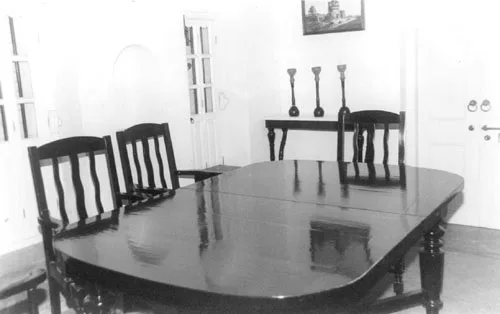
The untimely demise of his father made Vivekananda take the responsibility of his mother and his two younger brothers-Mahendranath and Bhupendranath. Mahendranath was an avid traveller, while Bhupendranath, was a patriot and was deeply involved in the Indian freedom struggle for which he had to take refuge outside the country. Their rooms too have been preserved with due honour.
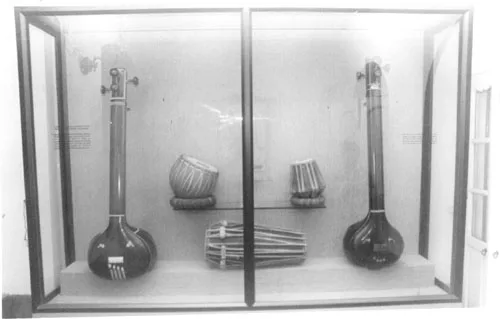
In one of the rooms in the ground floor, several musical instruments like tabla, khol and tanpura were displayed. Swamiji sang well and had learned the Indian Classical music from his father as well as renowned singers of the day like, Pt. Beni Adhikary and Ustad Ahammad Khan. He even wrote poetry for which he often composed music himself. Swamiji quite often played these instruments.
The textbook library comprises books prescribed for college students. Textbooks following the syllabii of five Universities, viz. the Universities of Calcutta, Jadavpur, Burdwan, Rabindra Bharati and Kalyani are kept here. The library already has 5,000 titles on different branches of science, commerce and arts. The research center named Vivekananda Research Centre is meant for conducting studies on various aspects of Indian culture, history, spirituality, the message of Shri Ramakrishna, Swaradama and Swami Vivekananda. It will have three main departments - Ramakrishna-Vivekananda studies, Religious Studies and Cultural and Scientific Studies. The building where philanthropic activities will be carried on is Rural and Slum Development Centre. This center will undertake studies on the problems of unemployment, health and sanitation in rural areas of Bengal .
An eminent British historian has described Swami Vivekananda as 'one of the main moulders of the modern world'. Indeed, many thought processes and social attributes of the 20th century show direct or indirect influence of Swamiji, although it may not have been always recognized as such. He was essentially a man without frontiers and must be honoured as one of the architects of global unity in the years to come. The present generation is fortunate enough to be able to maintain his birthplace as a heritage building.
InstanceEndEditable
InstanceBeginEditable name="Author Credit Bottom"
- www.vivekananda.net edited by Frank Parlato Jr.
InstanceEndEditable