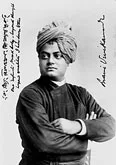
Mohammed
Mohammed's Message to the World
[Excerpts of Ida Ansell's first transcript of Swami Vivekananda's San Francisco lecture delivered Sunday, March 25, 1900]
[After stating that he would "take Mohammed and bring out the particular work of the great Arabian prophet", Swami Vivekananda continued his lecture.]
Each great messenger not only creates a new order of things, but is himself the creation of a certain order of things. There is no such thing as an independent, active cause. All causes are cause and effect in turn. Father is father and son in turn. Mother is mother and daughter in turn. It is necessary to understand the surroundings and circumstances into which they [the great messengers] come. . . .
This is the peculiarity of civilization. One wave of a race will go from its birthplace to a distant land and make a wonderful civilization. The rest will be left in barbarism. The Hindus came into India and the tribes of Central Asia were left in barbarism. Others came to Asia Minor and Europe. Then, you remember the coming out of Egypt of the Israelites. Their home was the Arabian desert. Out of that springs a new work. . . . All civilizations grow that way. A certain race becomes civilized. Then comes a nomad race. Nomads are always ready to fight. They come and conquer a race. They bring better blood, stronger physiques. They take up the mind of the conquered race and add that to their body and push civilization still further. One race becomes cultured and civilized until the body is worn out. Then like a whirlwind comes a race strong in the physical, and they take up the arts and the sciences and the mind, and push civilization further. This must be. Otherwise the world would not be.
* * * *
The moment a great man rises, they build a beautiful [mythology] around him. Science and truth is all the religion that exists. Truth is more beautiful than any mythology in the world. . . .
The old Greeks had disappeared already, the whole nation [lay] under the feet of the Romans who were learning their science and art. The Roman was a barbarian, a conquering man. He had no eye for poetry or art. He knew how to rule and how to get everything centralized into that system of Rome and to enjoy that. That was sweet. And that Roman Empire is gone, destroyed by all sorts of difficulties, luxury, a new foreign religion, and all that. Christianity had been already six hundred years in the Roman Empire. . . .
Whenever a new religion tries to force itself upon another race, it succeeds if the race is uncultured. If it [the race] is cultured, it will destroy the [religion]. . . . The Roman Empire was a case in point, and the Persian people saw that. Christianity was another thing with the barbarians in the north. [But] the Christianity of the Roman Empire was a mixture of everything, something from Persia, from the Jews, from India, from Greece, everything.
* * * *
The race is always killed by [war]. War takes away the best men, gets them killed, and the cowards are left at home. Thus comes the degeneration of the race. . . . Men became small. Why? All the great men became [warriors]. That is how war kills races, takes their best into the battlefields.
Then the monasteries. They all went to the desert, to the caves for meditation. The monasteries gradually became the centres of wealth and luxury. . . .
The Anglo-Saxon race would not be Anglo-Saxon but for these monasteries. Every weak man was worse than a slave.. . . In that state of chaos these monasteries were centres of light and protection.
Where [cultures] differ very much they do not quarrel. All these warring, jarring elements [were originally] all one.
In the midst of all this chaos was born the prophet. . . .
InstanceEndEditable
InstanceBeginEditable name="Author Credit Bottom"
- www.vivekananda.net edited by Frank Parlato Jr.
InstanceEndEditable