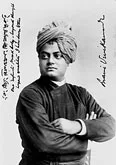
Teachings of Swami Vivekananda by Topic
The worship of the Divine Mother
(Fragmentary notes taken on a Sunday afternoon in New York in June, 1900)
From the tribal or clan-God, man arrives, in every religion, at the sum, the God of gods.
Confucius alone has expressed the one eternal idea of ethics. "Manu Deva" was transformed into Ahriman. In India, the mythological expression was suppressed; but the idea remained. In an old Veda is found the Mantra, "I am the empress of all that lives, the power in everything."
Mother-worship is a distinct philosophy in itself. Power is the first of our ideas. It impinges upon man at every step; power felt within is the soul; without, nature. And the battle between the two makes human life. All that we know or feel is but the resultant of these two forces. Man saw that the sun shines on the good and evil alike. Here was a new idea of God, as the Universal Power behind all — the Mother-idea was born.
Activity, according to Sânkhya, belongs to Prakriti, to nature, not to Purusha or soul. Of all feminine types in India, the mother is pre-eminent. The mother stands by her child through everything. Wife and children may desert a man, but his mother never! Mother, again, is the impartial energy of the universe, because of the colourless love that asks not, desires not, cares not for the evil in her child, but loves him the more. And today Mother-worship is the worship of all the highest classes amongst the Hindus.
The goal can only be described as something not yet attained. Here, there is no goal. This world is all alike the play of Mother. But we forget this. Even misery can be enjoyed when there is no selfishness, when we have become the witness of our own lives. The thinker of this philosophy has been struck by the idea that one power is behind all phenomena. In our thought of God, there is human limitation, personality: with Shakti comes the idea of One Universal Power. "I stretch the bow of Rudra when He desires to kill", says Shakti. The Upanisads did not develop this thought; for Vedanta does not care for the God-idea. But in the Gita comes the significant saying to Arjuna, "I am the real, and I am the unreal. I bring good, and I bring evil."
Again the idea slept. Later came the new philosophy. This universe is a composite fact of good and evil; and one Power must be manifesting through both. "A lame one-legged universe makes only a lame one-legged God." And this, in the end, lands us in want of sympathy and makes us brutal. The ethics built upon such a concept is an ethics of brutality. The saint hates the sinner, and the sinner struggles against the saint. Yet even this leads onward. For finally the wicked self-sufficient mind will die, crushed under repeated blows; and then we shall awake and know the Mother.
Eternal, unquestioning self-surrender to Mother alone can give us peace. Love Her for Herself, without fear or favour. Love Her because you are Her child. See Her in all, good and bad alike. Then alone will come "Sameness" and Bliss Eternal that is Mother Herself when we realise Her thus. Until then, misery will pursue us. Only resting in Mother are we safe.
InstanceEndEditable
InstanceBeginEditable name="Author Credit Bottom"
- www.vivekananda.net edited by Frank Parlato Jr.
InstanceEndEditable