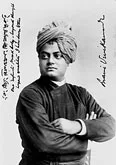
Teachings of Swami Vivekananda by Topic
Unity
(Notes of a lecture delivered at the Vedanta Society, New York, in June, 1900)
The different sectarian systems of India all radiate from one central idea of unity or dualism.
They are all under Vedanta, all interpreted by it. Their final essence is the teaching of unity. This, which we see as many, is God. We perceive matter, the world, manifold sensation. Yet there is but one existence.
These various names mark only differences of degree in the expression of that One. The worm of today is the God of tomorrow. These distinctions which we do love are all parts of one infinite fact, and only differ in the degree of expression. That one infinite fact is the attainment of freedom.
However mistaken we may be as to the method, all our struggle is really for freedom. We seek neither misery nor happiness, but freedom. This one aim is the secret of the insatiable thirst of man. Man's thirst, says the Hindu, man's thirst, says the Buddhist, is a burning, unquenchable thirst for more and more. You Americans are always looking for more pleasure, more enjoyment. You cannot be satisfied, true; but at bottom what you seek is freedom.
This vastness of his desire is really the sign of man's own infinitude. It is because he is infinite, that he can only be satisfied when his desire is infinite and its fulfilment infinite.
What then can satisfy man? Not gold. Not enjoyment. Not beauty. One Infinite alone can satisfy him, and that Infinite is Himself. When he realises this, then alone comes freedom.
"This flute, with the sense-organs as its keyholes,
With all its sensations, perceptions, and song,
Is singing only one thing. It longs to go back to the
wood whence it was cut!"
"Deliver thou thyself by thyself!
Ah, do not let thyself sink!
For thou art thyself thy greatest friend.
And thou thyself thy greatest enemy."
Who can help the Infinite? Even the hand that comes to you through the darkness will have to be your own.
Fear and desire are the two causes of all this, and who creates them? We ourselves. Our lives are but a passing from dream to dream. Man the infinite dreamer, dreaming finite dreams!
Oh, the blessedness of it, that nothing external can be eternal! They little know what they mean, whose hearts quake when they hear that nothing in this relative world can be eternal.
I am the infinite blue sky. Over me pass these clouds of various colours, remain a moment, and vanish. I am the same eternal blue. I am the witness, the same eternal witness of all. I see, therefore nature exists. I do not see, therefore she does not. Not one of us could see or speak if this infinite unity were broken for a moment.
InstanceEndEditable
InstanceBeginEditable name="Author Credit Bottom"
- www.vivekananda.net edited by Frank Parlato Jr.
InstanceEndEditable