(RECORDED BY MISS S. E. WALDO, A DISCIPLE
Inspired Talks
(RECORDED BY MISS S. E. WALDO, A DISCIPLE
SATURDAY, July 27, 1895. (Kathopanishad)
Learn not the truth of the Self save from one who has realised it; in all others it is mere talk. Realisation is beyond virtue and vice, beyond future and past; beyond all the pairs of opposites. "The stainless one sees the Self, and an eternal calm comes in the Soul." Talking, arguing, and reading books, the highest flights of the intellect, the Vedas themselves, all these cannot give knowledge of the Self.
In us are two — The God-soul and the man-soul. The sages know that the latter is but the shadow, that the former is the only real Sun.
Unless we join the mind with the senses, we get no report from eyes, nose, ears, etc. The external organs are used by the power of the mind. Do not let the senses go outside, and then you can get rid of body and the external world.
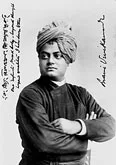
This very "x" which we see here as an external world, the departed see as heaven or hell according to their own mental states. Here and hereafter are two dreams, the latter modelled on the former; get rid of both, all is omnipresent, all is now. Nature, body, and mind go to death, not we; we never go nor come. The man Swami Vivekananda is in nature, is born, and dies; but the self which we see as Swami Vivekananda is never born and never dies. It is the eternal and unchangeable Reality.
The power of the mind is the same whether we divide it into five senses or whether we see only one. A blind man says, "Everything has a distinct echo, so I clap my hands and get that echo, and then I can tell everything that is around me." So in a fog the blind man can safely lead the seeing man. Fog or darkness makes no difference to him.
Control the mind, cut off the senses, then you are a Yogi; after that, all the rest will come. Refuse to hear, to see, to smell, to taste; take away the mental power from the external organs. You continually do it unconsciously as when your mind is absorbed; so you can learn to do it consciously. The mind can put the senses where it pleases. Get rid of the fundamental superstition that we are obliged to act through the body. We are not. Go into your own room and get the Upanishads out of your own Self. You are the greatest book that ever was or ever will be, the infinite depository of all that is. Until the inner teacher opens, all outside teaching is in vain. It must lead to the opening of the book of the heart to have any value.
The will is the "still small voice", the real Ruler who says "do" and "do not". It has done all that binds us. The ignorant will leads to bondage, the knowing will can free us. The will can be made strong in thousands of ways; every way is a kind of Yoga, but the systematised Yoga accomplishes the work more quickly. Bhakti, Karma, Raja, and Jnana-Yoga get over the ground more effectively. Put on all powers, philosophy, work, prayer, meditation — crowd all sail, put on all head of steam — reach the goal. The sooner, the better. . . .
Baptism is external purification symbolising the internal. It is of Buddhist origin.
The Eucharist is a survival of a very ancient custom of savage tribes. They sometimes killed their great chiefs and ate their flesh in order to obtain in themselves the qualities that made their leaders great. They believed that in such a way the characteristics that made the chief brave and wise would become theirs and make the whole tribe brave and wise, instead of only one man. Human sacrifice was also a Jewish idea and one that clung to them despite many chastisements from Jehovah. Jesus was gentle and loving, but to fit him into Jewish beliefs, the idea of human sacrifice, in the form of atonement or as a human scapegoat, had to come in. This cruel idea made Christianity depart from the teachings of Jesus himself and develop a spirit of persecution and bloodshed. . . .
Say, "it is my nature", never say, "It is my duty" — to do anything whatever.
"Truth alone triumphs, not untruth." Stand upon Truth, and you have got God.
* * *
From the earliest times in India the Brahmin caste have held themselves beyond all law; they claim to be gods. They are poor, but their weakness is that they seek power. Here are about sixty millions of people who are good and moral and hold no property, and they are what they are because from their birth they are taught that they are above law, above punishment. They feel themselves to be "twice-born", to be sons of God.
InstanceEndEditable
InstanceBeginEditable name="Author Credit Bottom"
- www.vivekananda.net edited by Frank Parlato Jr.
InstanceEndEditable