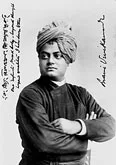
(RECORDED BY MISS S. E. WALDO, A DISCIPLE
Inspired Talks
(RECORDED BY MISS S. E. WALDO, A DISCIPLE
FRIDAY, July 19, 1895.
So long as I say "you", I have the right to speak of God protecting us. When I see another, I must take all the consequences and put in the third, the ideal, which stands between us; that is the apex of the triangle. The vapour becomes snow, then water, then Ganga; but when it is vapour, there is no Ganga, and when it is water, we think of no vapour in it. The idea of creation or change is inseparably connected with will. So long as we perceive this world in motion, we have to conceive will behind it. Physics proves the utter delusion of the senses; nothing really is as ever see, hear, feel, smell, taste it. Certain vibrations producing certain results affect our senses; we know only relative truth.
The Sanskrit word for truth is "isness" (Sat). From our present standpoint, this world appears to us as will and consciousness. Personal God is as much an entity for Himself as we are for ourselves, and no more. God can also be seen as a form, just as we are seen. As men, we must have a God; as God, we need none. This is why Shri Ramakrishna constantly saw the Divine Mother ever present with him, more real than any other thing around him; but in Samâdhi all went but the Self. Personal God comes nearer and nearer until He melts away, and there is no more Personal God and no more "I", all is merged in Self.
Consciousness is a bondage. The argument from design claims that intelligence precedes form; but if intelligence is the cause of anything, it itself is in its turn an effect. It is Maya. God creates us, and we create God, and this is Maya. The circle is unbroken; mind creates body, and body creates mind; the egg brings the chicken, the chicken the egg; the tree the seed, the seed the tree. The world is neither entirely differentiated nor yet entirely homogeneous. Man is free and must rise above both sides. Both are right in their place; but to reach truth, "isness", we must transcend all that we now know of existence, will, consciousness, doing, going, knowing. There is no real individuality of the Jiva (separate soul); eventually it, as a compound, will go to pieces. Only that which is beyond further analysis is "simple", and that alone is truth, freedom, immortality, bliss. All struggles for the preservation of this illusive individuality are really vices. All struggles to lose this individuality are virtues. Everything in the universe is trying to break down this individuality, either consciously or unconsciously. All morality is based upon the destruction of separateness or false individuality, because that is the cause of all sin. Morality exists first; later, religion codifies it. Customs come first, and then mythology follows to explain them. While things are happening, they come by a higher law than reasoning; that arises later in the attempt to understand them. Reasoning is not the motive power, it is "chewing the cud" afterwards. Reason is the historian of the actions of the human beings.
* * *
Buddha was a great Vedantist (for Buddhism was really only an offshoot of Vedanta), and Shankara is often called a "hidden Buddhist". Buddha made the analysis, Shankara made the synthesis out of it. Buddha never bowed down to anything — neither Veda, nor caste, nor priest, nor custom. He fearlessly reasoned so far as reason could take him. Such a fearless search for truth and such love for every living thing the world has never seen. Buddha was the Washington of the religious world; he conquered a throne only to give it to the world, as Washington did to the American people. He sought nothing for himself.
InstanceEndEditable
InstanceBeginEditable name="Author Credit Bottom"
- www.vivekananda.net edited by Frank Parlato Jr.
InstanceEndEditable