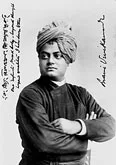
(RECORDED BY MISS S. E. WALDO, A DISCIPLE
Inspired Talks
(RECORDED BY MISS S. E. WALDO, A DISCIPLE
SATURDAY, July 13th, 1895.
Everything we know is a compound, and all sense-knowledge comes through analysis. To think that mind is a simple, single, or independent is dualism. Philosophy is not got by studying books; the more you read books, the more muddled becomes the mind. The idea of unthinking philosophers was that the mind was a simple, and this led them to believe in free-will. Psychology, the analysis of the mind, shows the mind to be a compound, and every compound must be held together by some outside force; so the will is bound by the combination of outside forces. Man cannot even will to eat unless he is hungry. Will is subject to desire. But we are free; everyone feels it.
The agnostic says this idea is a delusion. Then, how do you prove the world? Its only proof is that we all see it and feel it; so just as much we all feel freedom. If universal consensus affirms this world, then it must be accepted as affirming freedom; but freedom is not of the will as it is. The constitutional belief of man in freedom is the basis of all reasoning. Freedom is of the will as it was before it became bound. The very idea of free-will shows every moment man's struggle against bondage. The free can be only one, the Unconditioned, the Infinite, the Unlimited. Freedom in man is now a memory, an attempt towards freedom.
Everything in the universe is struggling to complete a circle, to return to its source, to return to its only real Source, Atman. The search for happiness is a struggle to find the balance, to restore the equilibrium. Morality is the struggle of the bound will to get free and is the proof that we have come from perfection. . . .
The idea of duty is the midday sun of misery scorching the very soul. "O king, drink this one drop of nectar and be happy." ("I am not the doer", this is the nectar.)
Let there be action without reaction; action is pleasant, all misery is reaction. The child puts its hand in the flame, that is pleasure; but when its system reacts, then comes the pain of burning. When we can stop that reaction, then we have nothing to fear. Control the brain and do not let it read the record; be the witness and do not react, only thus can you be happy. The happiest moments we ever know are when we entirely forget ourselves. Work of your own free will, not from duty. We have no duty. This world is just a gymnasium in which we play; our life is an eternal holiday.
The whole secret of existence is to have no fear. Never fear what will become of you, depend on no one. Only the moment you reject all help are you free. The full sponge can absorb no more.
* * *
Even fighting in self-defence is wrong, though it is higher than fighting in aggression. There is no "righteous" indignation, because indignation comes from not recognising sameness in all things.
InstanceEndEditable
InstanceBeginEditable name="Author Credit Bottom"
- www.vivekananda.net edited by Frank Parlato Jr.
InstanceEndEditable