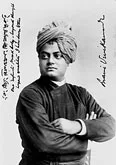
Complete books online by the Swami

Para-Bhakti or Supreme Devotion
Chapter 6: The higher knowledge and the higher love are one to the true lover
The Upanishads distinguish between a higher knowledge and a lower knowledge; and to the Bhakta there is really no difference between this higher knowledge and his higher love (Parâ-Bhakti). The Mundaka Upanishad says:

— "The knowers of the Brahman declare that there are two kinds of knowledge worthy to be known, namely, the Higher (Parâ) and the lower (Aparâ). Of these the lower (knowledge) consists of the Rig-Veda, the Yajur-Veda, the Sâma-Veda, the Atharva-Veda, the Shikshâ (or the science dealing with pronunciation and accent), the Kalpa (or the sacrificial liturgy), grammar, the Nirukta (or the science dealing with etymology and the meaning of words), prosody, and astronomy; and the higher (knowledge) is that by which that Unchangeable is known."
The higher knowledge is thus clearly shown to be the knowledge of the Brahman; and the Devi-Bhâgavata gives us the following definition of the higher love (Para-Bhakti): "As oil poured from one vessel to another falls in an unbroken line, so, when the mind in an unbroken stream thinks of the Lord, we have what is called Para-Bhakti or supreme love." This kind of undisturbed and ever-steady direction of the mind and the heart to the Lord with an inseparable attachment is indeed the highest manifestation of man's love to God. All other forms of Bhakti are only preparatory to the attainment of this highest form thereof, viz the Para-Bhakti which is also known as the love that comes after attachment (Râgânugâ). When this supreme love once comes into the heart of man, his mind will continuously think of God and remember nothing else. He will give no room in himself to thoughts other than those of God, and his soul will be unconquerably pure and will alone break all the bonds of mind and matter and become serenely free. He alone can worship the Lord in his own heart; to him forms, symbols, books, and doctrines are all unnecessary and are incapable of proving serviceable in any way. It is not easy to love the Lord thus. Ordinarily human love is seen to flourish only in places where it is returned; where love is not returned for love, cold indifference is the natural result. There are, however, rare instances in which we may notice love exhibiting itself even where there is no return of love. We may compare this kind of love, far purposes of illustration, to the love of the moth for the fire; the insect loves the fire, falls into it, and dies. It is indeed in the nature of this insect to love so. To love because it is the nature of love to love is undeniably the highest and the most unselfish manifestation of love that may be seen in the world. Such love, working itself out on the plane of spirituality, necessarily leads to the attainment of Para-Bhakti.
InstanceEndEditable
InstanceBeginEditable name="Author Credit Bottom"
- www.vivekananda.net edited by Frank Parlato Jr.
InstanceEndEditable