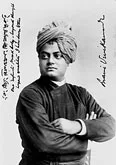
Complete books online by the Swami
Para-Bhakti or Supreme Devotion
Chapter 3: The naturalness of Bhakti-Yoga and its central secret
"Those who with constant attention always worship You, and those who worship the Undifferentiated, the Absolute, of these who are the greatest Yogis?" — Arjuna asked of Shri Krishna. The answer was: "Those who concentrating their minds on Me worship Me with eternal constancy and are endowed with the highest faith, they are My best worshippers, they are the greatest Yogis. Those that worship the Absolute, the Indescribable, the Undifferentiated, the Omnipresent, the Unthinkable, the All-comprehending, the Immovable, and the Eternal, by controlling the play of their organs and having the conviction of sameness in regard to all things, they also, being engaged in doing good to all beings, come to Me alone. But to those whose minds have been devoted to the unmanifested Absolute, the difficulty of the struggle along the way is much greater, for it is indeed with great difficulty that the path of the unmanifested Absolute is trodden by any embodied being. Those who, having offered up all their work unto Me, with entire reliance on Me, meditate on Me and worship Me without any attachment to anything else — them, I soon lift up from the ocean of ever-recurring births and deaths, as their mind is wholly attached to Me" (Gita, XII).
Jnâna-Yoga and Bhakti-Yoga are both referred to here. Both may be said to have been defined in the above passage. Jnana-Yoga is grand; it is high philosophy; and almost every human being thinks, curiously enough, that he can surely do everything required of him by philosophy; but it is really very difficult to live truly the life of philosophy. We are often apt to run into great dangers in trying to guide our life by philosophy. This world may be said to be divided between persons of demoniacal nature who think the care-taking of the body to be the be-all and the end-all of existence, and persons of godly nature who realise that the body is simply a means to an end, an instrument intended for the culture of the soul. The devil can and indeed does cite the scriptures for his own purpose; and thus the way of knowledge appears to offer justification to what the bad man does, as much as it offers inducements to what the good man does. This is the great danger in Jnana-Yoga. But Bhakti-Yoga is natural, sweet, and gentle; the Bhakta does not take such high flights as the Jnana-Yogi, and, therefore, he is not apt to have such big falls. Until the bandages of the soul pass away, it cannot of course be free, whatever may be the nature of the path that the religious man takes.
Here is a passage showing how, in the case of one of the blessed Gopis, the soul-binding chains of both merit and demerit were broken. "The intense pleasure in meditating on God took away the binding effects of her good deeds. Then her intense misery of soul in not attaining unto Him washed off all her sinful propensities; and then she became free." —
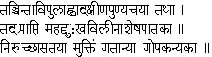
(Vishnu-Purâna). In Bhakti-Yoga the central secret is, therefore, to know that the various passions and feelings and emotions in the human heart are not wrong in themselves; only they have to be carefully controlled and given a higher and higher direction, until they attain the very highest condition of excellence. The highest direction is that which takes us to God; every other direction is lower. We find that pleasures and pains are very common and oft-recurring feelings in our lives. When a man feels pain because he has not wealth or some such worldly thing, he is giving a wrong direction to the feeling. Still pain has its uses. Let a man feel pain that he has not reached the Highest, that he has not reached God, and that pain will be to his salvation. When you become glad that you have a handful of coins, it is a wrong direction given to the faculty of joy; it should be given a higher direction, it must be made to serve the Highest Ideal. Pleasure in that kind of ideal must surely be our highest joy. This same thing is true of all our other feelings. The Bhakta says that not one of them is wrong, he gets hold of them all and points them unfailingly towards God.
InstanceEndEditable
InstanceBeginEditable name="Author Credit Bottom"
- www.vivekananda.net edited by Frank Parlato Jr.
InstanceEndEditable