
Swami Vivekananda

The common bases of Hinduism
On his arrival at Lahore the Swamiji was accorded a grand reception by the leaders, both of the Ârya Samâj and of the Sanâtana Dharma Sabhâ. During his brief stay in Lahore, Swamiji delivered three lectures. The first of these was on "The Common Bases of Hinduism", the second on Bhakti, and the
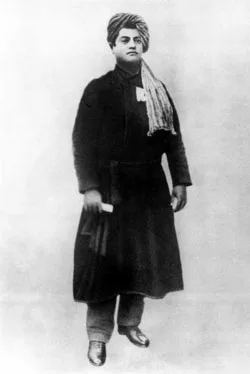
Paper on Hinduism Read at the Parliament on 19th September, 1893
Three religions now stand in the world which have come down to us from time prehistoric--Hinduism, Zoroastrianism and Judaism. They have all received tremendous shocks and all of them prove by their survival their internal strength. But while Judaism failed to absorb Christianity a
Fragmentary Notes on the Ramayana - Teachings of Swami Vivekananda by Topic
Worship Him who alone stands by us, whether we are doing good or are doing evil; who never leaves us even; as love never pulls down, as love knows no barter, no selfishness. Râma was the soul of the old king; but he was a king, and he could not go back on his word. "Wherever Rama goes, there go I
Heaven - Teachings of Swami Vivekananda by Topic
If we had a heaven like that desired by those to whom sense-enjoyment is the very end of existence, then we would not progress. That would be the most terrible curse we could pronounce on the soul. Is this all we can come to? A little weeping and dancing, and then to die like a dog! What a curse you
Who is a Real Guru? - Teachings of Swami Vivekananda by Topic
A real Guru is one who is born from time to time as a repository of spiritual force which he transmits to future generations through successive links of Guru and Shishya (disciple). The current of this spirit-force changes its course from time to time, just as a mighty stream of water opens up a
The Complete Works of Swami Vivekananda
To understand the Gita requires its historical background. The Gita is a commentary on the Upanishads. The Upanishads are the Bible of India. They occupy the same place as the New Testament does. There are [more than] a hundred books comprising the Upanishads, some very small and s
The Complete Works of Swami Vivekananda
This article was recorded by Ida Ansell in shorthand. As, however, Swamiji's speed was too great for her in her early days, dots are put in the articles to indicate the omissions, while the words within square brackets are added by way of linking up the disconnected parts.
Ishvara and Brahman - Teachings of Swami Vivekananda by Topic
In reply to a question as to the exact position of Ishvara in Vedantic Philosophy, the Swami Vivekananda, while in Europe, gave the following definition:
Teachings of Swami Vivekananda by Topic
The idea that nature in all her orderly arrangements shows design on the part of the Creator of the universe is good as a kindergarten teaching to show the beauty, power, and glory of God, in order to lead children in religion up to a philosophical conception of God; but apart from that, it is n
Law and Freedom - Teachings of Swami Vivekananda by Topic
The struggle never had meaning for the man who is free. But for us it has a meaning, because it is name-and-form that creates the world. We have a place for struggle in the Vedanta, but not for fear. All fears will vanish when you begin to assert your own nature. If you think that you are bound,
Freedom of the Self - Teachings of Swami Vivekananda by Topic
As we cannot know except through effects that we have eyes, so we cannot see the Self except by Its effects. It cannot be brought down to the low plane of sense-perception. It is the condition of everything in the universe, though Itself unconditioned. When we know that we are the Self, then we
How to Become Free - Teachings of Swami Vivekananda by Topic
All things in nature work according to law. Nothing is excepted. The mind as well as everything in external nature is governed and controlled by law. Internal and external nature, mind and matter, are in time and space, and are bound by the law of causation. The freedom of the mind is a delusion.